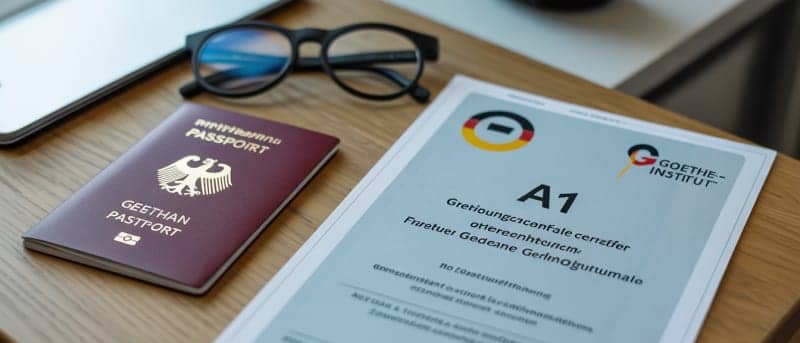
A1 Certificate Requirements for Spouse Visas (2026)
TL;DR
For a spouse visa (family reunification) to join your partner in Germany you usually need an A1 German certificate from an approved provider. As of 2026 only Goethe-Institut, Telc, or ÖSD certificates are accepted. The certificate doesn’t expire, but you must upload it to the Consular Services Portal as part of your digital application.
What this means for you
Only three providers count. Certificates from other language schools or “CEFR A1” courses are not accepted. Book your A1 test early—from registration to certificate in hand often takes 2–3 months. If you might be exempt (e.g. certain nationalities or Blue Card spouses), check before you pay for a test; our
spouse visa exemptions guide has the details.
Who Needs A1 for Spouse Visas?
If you’re applying for a family reunification visa to join your spouse or registered partner in Germany, you generally need to show A1 German. That applies to most applicants. There are exemptions—for example citizens of Australia, Canada, Israel, Japan, New Zealand, South Korea, USA, and some others, plus certain professionals and medical/disability cases. Full list and conditions: Spouse Visa Exemptions: Who Doesn’t Need A1 German (2026).
Usually required: spouses of German citizens, of EU/EEA citizens, and of permanent residents; registered partners. Fiancé(e)s may need it depending on visa type.
Approved Certificate Providers (2026)
German immigration accepts A1 certificates from only three providers. Anything else—other language schools, online courses, or “CEFR A1” certificates from elsewhere—is not accepted for the visa.
1. Goethe-Institut
Goethe-Zertifikat A1: Start Deutsch 1. Four parts: reading, writing, listening, speaking. Available at Goethe-Institut and authorised test centres worldwide. Certificate has no expiry. Goethe-Institut A1 exam (goethe.de)
2. Telc
Telc Deutsch A1 (or Start Deutsch 1 / telc Deutsch A1). Same four skills. Telc test centres worldwide. No expiry. Telc Deutsch A1 (telc.net)
3. ÖSD
ÖSD Zertifikat A1. Reading, writing, listening, speaking. ÖSD test centres worldwide. No expiry. ÖSD Zertifikat A1 (osd.at)
Certificate Validity
A1 certificates from Goethe, Telc, and ÖSD do not expire. You don’t have to retake the test. Some offices prefer a certificate that’s not too old (e.g. within 2–3 years); that’s not a legal rule, but worth bearing in mind. Keep the certificate readable and in good condition. For the visa you’ll upload a scan to the Consular Services Portal—keep the original for the mission if they ask.
Timeline: Register 4–8 weeks before your desired test date. Results often 2–4 weeks after the test; the physical certificate can take another 2–4 weeks. All in all, plan for about 2–3 months from registration to having the certificate in hand.
Berlin LEA Stricter Rules (December 2024)
From December 2024 the Berlin LEA (Landesamt für Einwanderung) tightened language-certificate rules for all immigration applications, including spouse visas.
All language certificates must be uploaded digitally to the Consular Services Portal. You can’t substitute a general statement like “I have basic German”—you need an official certificate from Goethe, Telc, or ÖSD. Certificates are checked against the approved list. More on how this affects all visa types: Berlin LEA Stricter Mandate: Mandatory Language Certificates (2026 Update).
Digital Application: Uploading Your Certificate
Spouse visa applications go through the Consular Services Portal. Upload a clear scan of your full A1 certificate (PDF or good-quality JPG/PNG, usually max 5–10 MB per file). The text must be readable; include front and back if there’s information on both. Use German or English, or an official translation.
In short: Create an account, start the spouse visa application, open the language section, upload the certificate, double-check it’s readable, then submit. If the file is too big, compress it; if quality is poor, rescan. The portal will tell you if a format isn’t accepted—PDF is safest.
Exemptions and Special Cases
Many applicants need A1, but not everyone. Citizens of Australia, Canada, Israel, Japan, New Zealand, South Korea, and the USA are often exempt. So may be some highly qualified professionals, researchers, and spouses of EU Blue Card holders (different rules apply). Medical or disability grounds can also lead to exemptions, with supporting documents. If you’ve already shown integration (e.g. previous residence or you have B1 or higher), you might not need A1—you may need to prove the higher level instead. Full list and conditions: Spouse Visa Exemptions (2026).
Even if you’re from an exempt country, your mission may still ask for some language evidence. Check the embassy or consulate that handles your case.
From A1 Test to Visa: Steps
1. Check if you need A1. See exemptions above; if in doubt, ask your German mission.
2. Choose a provider. Goethe, Telc, or ÖSD—whichever has a test centre near you. Compare dates and fees (often around €100–€200).
3. Register and sit the test. Book well in advance. Prepare for all four skills; use the provider’s sample materials. On the day, bring ID and follow the centre’s instructions.
4. Get your certificate. Results usually in 2–4 weeks; then the physical (or digital) certificate. Check that your name and details are correct and keep the original safe.
5. Scan and apply. Scan the certificate clearly (PDF or good image, under 10 MB). On the Consular Services Portal, start your spouse visa application, upload the certificate in the language section, complete the rest, and submit. Track the application and reply quickly to any extra requests. Take the original to the mission if they ask. Processing times: Spouse Visa Processing Time Germany (2026).
Frequently Asked Questions
Do I need A1 for a spouse visa?
In most cases, yes. Exceptions apply for certain nationalities (e.g. Australia, Canada, Israel, Japan, New Zealand, South Korea, USA) and other situations. See Spouse Visa Exemptions (2026).
Which certificates are accepted?
Only Goethe-Institut (Start Deutsch 1), Telc (Telc Deutsch A1), and ÖSD (ÖSD Zertifikat A1). No other providers, language schools, or online courses—even if they say “CEFR A1.”
Does the A1 certificate expire?
No. Goethe, Telc, and ÖSD certificates don’t have an expiry date. Some offices prefer a recent certificate (e.g. last 2–3 years); that’s not required by law.
Can I use a certificate from a language school or online course?
No. Only official certificates from Goethe, Telc, or ÖSD from an authorised test centre are accepted.
What is the Berlin LEA stricter mandate?
From December 2024, Berlin’s LEA requires all language certificates to be uploaded to the Consular Services Portal and no longer accepts general “knowledge of German” statements. You must have an approved certificate. More: Berlin LEA Mandate (2026).
How long does it take to get the A1 certificate?
Plan for about 2–3 months from registration to certificate in hand: booking, test date, results, and delivery. Start early if you’re aiming for a spouse visa.
Official Sources
Last checked: February 2026.
Next Steps
If you’re planning a spouse visa: check whether you’re exempt, then pick Goethe, Telc, or ÖSD and register for the A1 test in good time. Prepare with official practice materials, sit the test, get your certificate, and upload a clear scan when you apply on the Consular Services Portal. Starting early avoids last-minute delays.
More on language and residence: Permanent Residency Germany: All Visa Types & Language Requirements (2026), Spouse Visa Exemptions (2026), Spouse Visa Processing Time (2026), B1 and permanent residency (21 vs 33 months), EU Blue Card 21-month track, German university graduate pathways, and Leben in Deutschland integration test (for citizenship).