Understanding the EU Blue Card to Permanent Residency Journey in Germany
In 2026, the EU Blue Card is still one of the quickest routes to permanent residency in Germany for highly qualified professionals. This guide walks through the journey from Blue Card to Niederlassungserlaubnis: the 2026 salary thresholds, the two main tracks (21 months and 33 months), and how it works for IT specialists without a degree.
What this means for you
If you’re on a Blue Card (or about to get one): you can aim for permanent residency in 21 months with B1 German, or 33 months with A1. Start language and integration-test prep early—many people miss the 21-month track because they only start German at month 12. In 2026 the salary bar is €50,700 for most jobs and €45,934.20 for shortage occupations and IT (no degree needed if you have 3 years’ experience and proof of theoretical knowledge). Applications go through the Consular Services Portal; you must upload a recognised language certificate.
Why this timeline matters: I’ve seen a lot of Blue Card holders leave things too late. Alex, a software engineer, thought he had plenty of time to learn German. By month 18 he realised he needed B1 for the 21-month track but was only at A2—he had to switch to the 33-month route and add a year. Maria, an IT specialist without a degree, qualified for the Blue Card on experience but didn’t start German until month 12. She couldn’t reach B1 by month 21 and had to take the longer track. The takeaway: plan the residency path from day one of your Blue Card, not only when you’re ready to apply. This guide brings together what you need for both pathways, including the options for IT specialists without a degree.
What is the EU Blue Card?
The EU Blue Card is a residence permit for highly qualified non-EU nationals working in Germany. It gives you:
- A fast route to permanent residency (21 or 33 months, depending on German level)
- Family reunification and work rights for your spouse
- Mobility in the EU after 18 months
- Validity of up to 4 years (depending on your contract)
2026 Blue Card Salary Thresholds
From January 1, 2026, the thresholds are:
General occupations
- Minimum gross annual salary: €50,700
- Roughly: €4,225 per month
- Applies to most roles that require a university degree
Shortage occupations & IT specialists
- Minimum gross annual salary: €45,934.20 (2026)
- Roughly: €3,827.85 per month
- Applies to IT specialists, shortage occupations, young professionals, and (for IT) no degree is required if you have 3 years’ experience and evidence of theoretical knowledge
IT Specialists Without a Degree: 2026 Rules
IT specialists can get the EU Blue Card without a university degree if they meet experience and salary requirements.
What you need (IT, no degree)
- Experience: At least 3 years of relevant IT work in the last 7 years
- Salary: At least €45,934.20 gross per year (2026 shortage threshold)
- Job offer: Concrete offer from a German employer for an IT role
- Contract: Minimum 6 months
- Theoretical knowledge: Certifications, training, or professional exams that show knowledge comparable to university level
Documentation that helps
Authorities want to see both experience and some form of “theoretical” knowledge. David had five years in IT but no degree. He submitted AWS, Kubernetes, and Azure certs plus a bootcamp certificate; the office accepted that combination. Sarah had four years’ experience but older certs—she did a recent cloud architecture course and then got approval. So: gather certs, training certificates, and any professional courses; the aim is to show experience plus structured knowledge, not only years of work.
- Employment references or proof of professional experience
- Job description from the employer
- Employment contract (salary and role)
- Certificates or proof of theoretical knowledge (IT certs, training)
- CV with a clear professional history
Complete Timeline: Blue Card to Permanent Residency
You have two paths, depending on your German level:
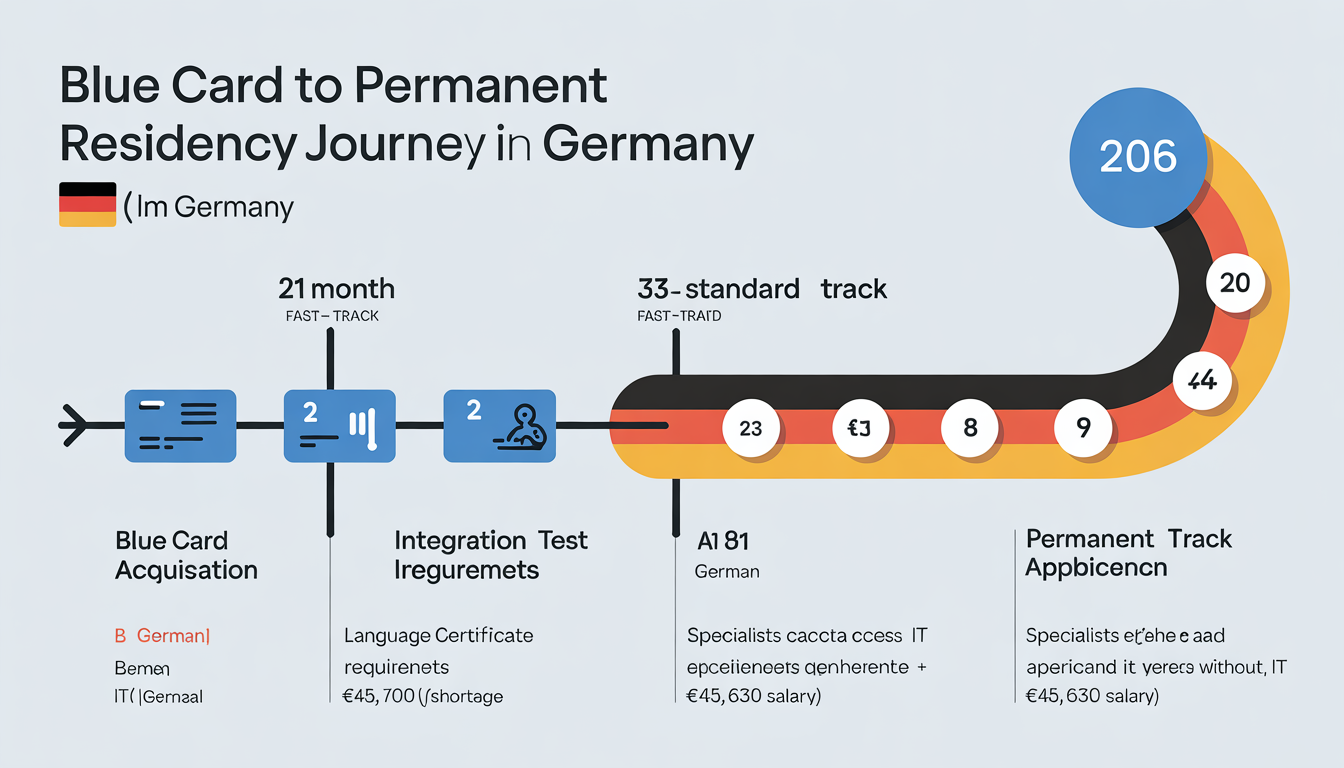
Pathway 1: 21-month fast-track (B1 required)
Rough timeline:
- Month 0: Blue Card issued
- Months 1–21: Work, pay into the pension system, and reach B1
- Month 21: Apply for permanent residency (Niederlassungserlaubnis)
- Months 22–24: Processing (often 4–8 weeks)
You need: 21 months’ employment on Blue Card, 21 months’ pension contributions, B1 certificate (Goethe, Telc, or ÖSD), “Leben in Deutschland” test, secure livelihood, health insurance, and adequate housing.
Pathway 2: 33-month standard track (A1 required)
Rough timeline:
- Month 0: Blue Card issued
- Months 1–33: Work, pay into pension, reach A1
- Month 33: Apply for permanent residency
- Months 34–36: Processing
You need: 33 months’ employment on Blue Card, 33 months’ pension contributions, A1 certificate, “Leben in Deutschland” test, plus the same livelihood, insurance, and housing requirements.
Month-by-Month Snapshot
Months 1–6
Start the job and pension contributions. Use this time to assess your German and decide: 21-month (B1) or 33-month (A1) track.
Months 7–12
21-month track: intensive B1 prep. 33-month track: start A1. Around month 12, check whether you’re on course for your chosen path.
Months 13–18
21-month: sit B1 and the integration test, gather documents. 33-month: continue language, take A1 when ready. At month 18, 21-month applicants have about three months left to apply.
Months 19–21 (21-month track)
Finish “Leben in Deutschland,” collect all documents, and submit via the Consular Services Portal at month 21.
Months 22–33 (33-month track)
Keep working and contributing. Complete the integration test and documents in good time; submit at month 33.
Key Milestones and Requirements
Getting the Blue Card (month 0)
- Salary: €50,700 (general) or €45,934.20 (shortage/IT) in 2026
- Recognised degree, or (for IT) 3 years’ experience + theoretical knowledge
- Concrete job offer and contract (min. 6 months)
- Federal Employment Agency approval where required
Language certificate
- 21-month: B1 from Goethe, Telc, or ÖSD
- 33-month: A1 from Goethe, Telc, or ÖSD
- Certificate usually no older than about a year at application—confirm with your office
- Upload via Consular Services Portal
Integration test
“Leben in Deutschland” or (where accepted) Einbürgerungstest. Required for both tracks.
Permanent residency application
Submit via the Consular Services Portal with Blue Card, passport, contract, pension records, language certificate, and integration test certificate. Fee typically €113–147; processing often 4–8 weeks.
Comparison: 21-Month vs 33-Month
| Criteria |
21-Month |
33-Month |
| Time to permanent residency |
21 months |
33 months |
| German |
B1 |
A1 |
| Certificate |
Goethe, Telc, or ÖSD B1 |
Goethe, Telc, or ÖSD A1 |
| Pension contributions |
21 months |
33 months |
| Integration test |
Required |
Required |
| Best for |
You already have or can reach B1 quickly |
You need more time for language |
Benefits of the EU Blue Card
- Faster permanent residency: 21–33 months vs. typically 5 years on other work permits
- Family: Spouse can work without a separate work permit
- EU mobility: After 18 months you can work in other EU countries under the scheme
- Validity: Up to 4 years depending on contract
- Job change: After 2 years you can change employers (with notification)
2026 Updates
- Salary thresholds: General €50,700; shortage/IT €45,934.20 (2026)
- IT without degree: 3 years’ experience + €45,934.20 + evidence of theoretical knowledge
- Applications: Via Consular Services Portal
- Language proof: Recognised certificate upload required; less discretion for “conversational” proof
- Integration test: Mandatory for permanent residency
Official sources & last checked
Rules come from residence law and the authorities. We used:
Last checked: February 2026. Always confirm with your Ausländerbehörde or the portal.
Common Questions
Can I switch from 33-month to 21-month?
Yes. If you reach B1 before 33 months, you can apply at 21 months instead.
What if I lose my job during the Blue Card period?
You usually have a few months to find new employment that still meets Blue Card conditions. Time already accumulated generally still counts toward permanent residency.
Can my family join?
Yes. Spouse and children can join; spouses get work authorisation without a separate work permit.
Next Steps
- Check you meet the 2026 salary (€50,700 or €45,934.20 for shortage/IT)
- IT without degree: confirm 3 years’ experience and evidence of theoretical knowledge
- Get a concrete job offer and apply for the Blue Card via the Consular Services Portal
- From day one, plan language: B1 for 21-month, A1 for 33-month
- Pay into the pension system from the start and track your months
- Book the integration test and language exam in good time
Summary: the 21-month track needs B1 but shortens the wait by a year. Choose the track that fits your current German and how fast you can realistically reach B1 or A1.