Berlin LEA Stricter Mandate: Mandatory Language Certificates (2026)
TL;DR
In December 2024 the Berlin LEA (Landesamt für Einwanderung) tightened language-certificate rules for all immigration applications. You can no longer rely on a general “knowledge of German” statement—you must upload an official certificate from Goethe-Institut, Telc, or ÖSD to the Consular Services Portal. This applies to spouse visas, permanent residency, citizenship, and other types when language proof is required.
What this means for you
If you apply in or after December 2024, you need a real certificate from one of the three providers. No exceptions for “I speak German” or certificates from other schools. Book your test in good time (results often take 2–4 weeks, plus delivery). Spouse visas need A1; permanent residency and citizenship usually need B1 plus the integration test.
What Changed in December 2024?
The Berlin LEA handles a large share of immigration applications in Germany. Until late 2024, practice varied: some offices accepted general statements about German; standards differed by office. From December 2024 the rules are clear and uniform.
Before: Some offices accepted general “knowledge of German”; proof could be paper; enforcement was inconsistent.
Now (2025–2026): Only official certificates from approved providers. All certificates must be uploaded to the Consular Services Portal. No general statements. Certificates are checked against the approved list. Same standard for everyone.
So if you’re applying for anything that requires language proof—spouse visa, permanent residency, citizenship, or another permit that asks for German—you need an approved certificate and a digital upload.
Timeline
| Period |
Policy |
Status |
| Before 2024 |
Flexible; general statements sometimes accepted |
No longer valid |
| Early 2024 |
Some offices started requiring certificates |
Transition |
| December 2024 |
Berlin LEA mandate in force |
Change date |
| 2025–2026 |
Strict enforcement; digital upload required |
Current |
Applications submitted after December 2024 must follow the new rules. Older applications may still be handled under the previous practice, but if the LEA revisits your case later, they may ask for a certificate.
How It Affects Different Visa Types
Spouse visas (family reunification)
A1 from Goethe, Telc, or ÖSD—uploaded to the Consular Services Portal. No general statements. Details: A1 for Spouse Visas (2026). Who’s exempt: Spouse Visa Exemptions (2026).
Permanent residency
Usually B1 plus the “Leben in Deutschland” integration test. Certificate must be uploaded digitally. Level and pathways: B1: 21 vs 33 Months (2026), Permanent Residency: All Visa Types & Language Requirements (2026). Faster routes: EU Blue Card 21-month track, German university graduate 2-year pathway.
Citizenship
B1 and the “Leben in Deutschland” (or Einbürgerungstest) test. Everything uploaded digitally; no general language statements. Current rules: German Citizenship 2026: 3-Year Fast-Track Abolished. Test guide: Leben in Deutschland (2026).
EU Blue Card and skilled worker visas
When the visa type requires language proof, only approved certificates count, and they must be uploaded to the portal. Level depends on the permit. EU Blue Card Permanent Residency Timeline (2026).
Approved Providers
Only three: Goethe-Institut, Telc, and ÖSD. All levels (A1–C2) from these providers are accepted. Anything else—other language schools, online courses, or “CEFR” certificates from elsewhere—is not accepted.
Digital Upload
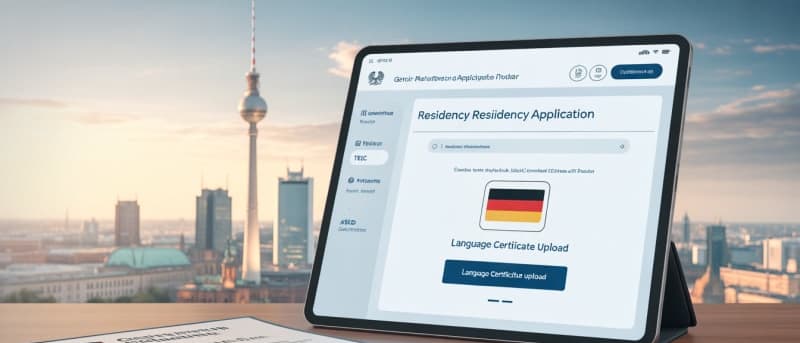
Certificates must be uploaded in the Consular Services Portal as part of your application. Use PDF or a clear scan (JPG/PNG), usually max 5–10 MB. The whole certificate must be readable—front and back if there’s content on both. German or English (or official translation) is fine.
Steps: Register on the portal, start your application, open the language section, upload the certificate, check that it’s readable, then complete and submit. If the file is too big, compress it; if the format isn’t accepted, use PDF. Include every page if the certificate has more than one.
If You Applied Before December 2024
Applications already in the system may still be processed under the old rules. Check your status on the portal. If the LEA reviews or reopens your case after December 2024, they can still ask for an approved certificate—so have one ready if you can.
All applications submitted after December 2024 must meet the new rules: approved certificate and digital upload.
Why the Change?
Berlin LEA moved to one standard so everyone is judged the same way. Official certificates are easier to verify and reduce misuse. Digital uploads also speed up processing and fit the move to online applications.
If You Don’t Have a Certificate Yet
Spouse visas → usually A1. Permanent residency / citizenship → usually B1 (plus integration test for both). Other visas → check the requirements for your permit.
Pick Goethe, Telc, or ÖSD, find a test centre and date, register, and prepare. After the test, allow 2–4 weeks for results and then for the certificate. Scan it clearly (PDF or good image, under 10 MB) and upload it when you apply on the portal. Full A1 flow for spouses: A1 for Spouse Visas (2026); who’s exempt: Spouse Visa Exemptions (2026); processing: Spouse Visa Processing Time (2026).
Frequently Asked Questions
What is the Berlin LEA stricter mandate?
From December 2024, the Berlin LEA (Landesamt für Einwanderung) requires official language certificates from Goethe, Telc, or ÖSD for all relevant immigration applications. Certificates must be uploaded to the Consular Services Portal. General “knowledge of German” statements are no longer accepted. This applies to spouse visas, permanent residency, citizenship, and other types when language is required.
When did it start?
December 2024. Applications submitted after that must follow the new rules. Older applications may still be processed under the previous policy.
Does it apply to all visa types?
Yes, for everything the Berlin LEA handles that requires language proof. When a visa or permit needs German, it must be an approved certificate—A1 for spouse visas, typically B1 for permanent residency and citizenship.
Can I still use a general statement about my German?
No. You need an official certificate from Goethe, Telc, or ÖSD. Other providers or “CEFR” certificates from language schools are not accepted.
I applied before December 2024. What now?
Your case may still be processed under the old rules. If the LEA looks at your file again after December 2024, they may request a certificate. Check the portal and be ready to submit one if asked.
How do I upload my certificate?
In the Consular Services Portal: create an account, start your visa or residence application, go to the language certificate section, upload a clear scan (PDF or image, under 10 MB), confirm it’s readable, then complete and submit. The certificate must be from Goethe, Telc, or ÖSD.
Official Sources
Last checked: February 2026.
Next Steps
Confirm which level you need (A1 or B1 for most cases), book a test with Goethe, Telc, or ÖSD, get your certificate, and scan it for upload. Apply via the Consular Services Portal and upload the certificate in the language section. Follow your application online and reply quickly to any extra requests.
More on your situation: A1 for Spouse Visas (2026), Spouse Visa Exemptions (2026), Spouse Visa Processing Time (2026), B1: 21 vs 33 Months (2026), Permanent Residency: All Visa Types & Language (2026), EU Blue Card Timeline (2026), German University Graduates (2026), Leben in Deutschland (2026), German Citizenship 2026.