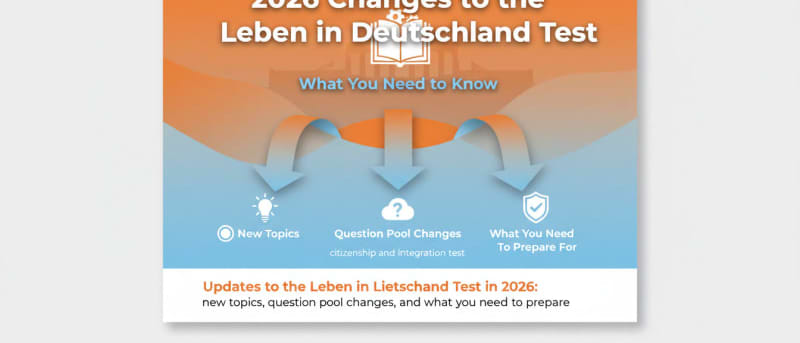
2026 Changes to the Leben in Deutschland Test: What You Need to Know
When I was finishing my integration course, I had to take the Leben in Deutschland (LiD) test. I'd heard rumours that the 2024 citizenship law reform would change the question pool, so I searched for what exactly was different in 2026. Here's what I found: the format is the same (33 multiple-choice questions, 60 minutes), but the content has been updated to reflect new laws and values. In this guide I'll cover what the LiD test is, the 2026 changes to topics and the question pool, who must take it, and how to prepare. If you're aiming for Niederlassungserlaubnis, German citizenship, or finishing your integration course, this test matters—and the 2026 updates are worth understanding before you sit it.
What is the Leben in Deutschland (LiD) Test?
The Leben in Deutschland test is the final examination for the Orientation Course, which is part of the BAMF Integration Course. It covers Germany's legal system, history, and culture (Rechtsordnung, Geschichte und Kultur). The test has a dual function: it serves as the final certificate for the integration course and, if you achieve the required score, as the Einbürgerungstest (citizenship test). So you can use the same test for both integration and naturalization—you don't need to sit two separate exams. The questions are multiple-choice: you receive a paper with 33 questions and must choose one correct answer out of four for each. You have 60 minutes. For more on the citizenship path, see our news section and learning resources.
2026 Changes: Topics, Pool, and Format
Format: As of early 2026, there has been no fundamental change to the test format. It's still 33 multiple-choice questions in 60 minutes. What has changed is the content of the question pool. The BAMF periodically updates the questions to reflect current laws and political developments.
Question pool: The pool remains at 310 questions total: 300 general questions (covering all of Germany) plus 10 specific to your Federal State (Bundesland). Your 33 questions are drawn from this pool, including at least a few from your Bundesland.
2024–2026 updates: Following the 2024 Citizenship Law Reform (Staatsangehörigkeitsgesetz), more questions on Israel, Judaism, and Germany's commitment to democratic values and against antisemitism have been integrated into the active pool. This reflects the legal requirement that citizenship applicants understand and uphold democratic principles. If you're using old study materials, they may not include these newer questions—so always practise from the official BAMF Online Testcenter.
When do 2026 changes apply? Updates to the question pool are usually implemented as soon as new laws or policies take effect. For the latest announcements, check the BAMF newsroom and official LiD pages.
Who Must Take It
Integration course participants: The test is mandatory for anyone finishing the BAMF orientation module who wants to receive the full Integration Course certificate. If you're in an integration course, your provider will arrange the test.
Citizenship applicants: The Einbürgerungstest 2026 (or the LiD with a passing score for citizenship) is required for naturalization, unless you have a German school-leaving certificate or a degree in social or political sciences from a German university.
Permanent residency: The test is also required for the Niederlassungserlaubnis to prove "basic knowledge of the legal and social order" in Germany.
Exemptions: Usually granted for minors, seniors with significant health issues, or those with specific German educational qualifications. If you're unsure whether you need to take it, check with your local Einbürgerungsbehörde or Ausländerbehörde.
How to Prepare
From what I found when I was preparing:
- The official question pool: The BAMF Online Testcenter is the only official source to practise all 310 questions. It's free and updated when the pool changes. I used it almost every day before my test.
- Orientation course: Attending the 100-hour orientation course is the primary way to learn the context behind the questions. The course covers German history, law, culture, and values—so you understand not just the answers but why they matter.
- Official apps: BAMF-approved apps like 'Ankommen' offer practice modes. They're useful for on-the-go revision, but the Online Testcenter is the most complete source.
For more support on language and citizenship requirements, see our learning resources and our guide on Goethe B1 vs Telc B1 for citizenship.
Frequently Asked Questions
How many questions are on the test?
You receive a paper with 33 multiple-choice questions. For each question you must choose one correct answer out of four options. You have 60 minutes to complete the test.
What is the pass mark?
It depends on your goal. To pass the integration course, you need 15 out of 33 correct. To use the test for citizenship (Einbürgerung), you must score at least 17 out of 33. So if you're planning to apply for naturalization, aim for 17 or higher.
When do 2026 changes apply?
Changes to the question pool are usually implemented immediately when legislative updates take effect. The BAMF does not always announce every single change in advance. For the latest information, check the BAMF newsroom and the official LiD test description.
Can I retake the test?
Yes. The test can be repeated as many times as necessary. If you take it as part of the integration course, retakes may be covered. If you're an external participant (booking independently), there is usually a fee of approximately €25 per attempt.
Is the Leben in Deutschland test different from the Einbürgerungstest?
The questions are identical. The difference is context: the LiD test is taken as part of the integration course, while the Einbürgerungstest is booked independently at a testing center. The certificate you receive can be used for both integration and citizenship, provided you meet the required score (17+ for citizenship).
Next Steps
If you're preparing for the Leben in Deutschland test 2026, start with the official BAMF Online Testcenter and work through all 310 questions. Attend the orientation course if you can—it makes a big difference. For updates on citizenship law and integration requirements, follow our news section. And if you need to prove your German level (e.g. B1 for citizenship) as well, check our guide on citizenship language requirements.
CTA: Read our citizenship language guide to see which B1 exam fits your naturalization path.
Official sources & references
Authoritative links for the Leben in Deutschland test, Einbürgerungstest, question pool, and citizenship reform mentioned in this guide.