German Adjective Endings: The "One-Table" Shortcut (2026)
Adjective endings decide whether your German sounds polished or unfinished. Learners who already command tenses and cases often stumble when faced with tables full of -e, -en, -em, and -er. This master plan transforms abstract declension charts into intuitive flows, vivid visuals, and practice loops. Drawing on Goethe-Institut curricula, TELC grading rubrics, Duden grammar references, and corpora such as DWDS, it equips you with decision trees, printable cheat sheets, exception trackers, and a regimented review schedule. By the end you will recognize adjective ending patterns at sight, deploy them instinctively in speaking and writing, and know how to maintain your accuracy long-term.
The workbook offers more than theory. You will find benchmarking diagnostics, usage statistics across registers, context-rich drills for business and academic scenarios, classroom games, self-study routines with spaced repetition, as well as a troubleshooting clinic that addresses fossilized errors. Use the Table of Contents below to jump to the sections most relevant for your current learning stage.
Table of Contents
1. Why Adjective Endings Are High-Value Skills at B1+
Once you reach B1 level, examiners and employers expect accuracy beyond basic word order. Adjective endings show mastery of case, gender, and number simultaneously. In writing tasks, missing endings lower cohesion scores. In speaking exams, incorrect endings are marked as „Grammatikfehler“ that reduce your range even when content is strong. DWDS corpus analysis of newspaper editorials reveals that adjective endings appear on average three times per sentence, emphasizing their ubiquity. By investing focused effort here you unlock instant credibility and can concentrate on stylistic flourishes instead of baseline correctness.
Accuracy in adjective endings also supports reading comprehension. Recognizing den neuen Vertrag vs. der neue Vertrag tells you whether the text refers to a direct object or subject, while des neuen Vertrages hints at possessive relationships. The skill therefore interacts with every other grammar layer you have built so far.
2. Grammar Foundation: Gender, Case, Definiteness Recap
Before launching into declension patterns, solidify the foundations:
- Gender and number: All nouns fall into masculine, feminine, neuter, or plural categories. You should already be logging noun gender in your vocabulary notes. Color coding helps (blue for masculine, red for feminine, green for neuter, orange for plural).
- Case functions: Subject (nominative), direct object (accusative), indirect object (dative), possession/relationship (genitive). Mastering the cases ensures you know which column of the declension chart to use.
- Definiteness: Determine if the noun is introduced with definite article (der/die/das), indefinite article (ein/eine), possessive (mein, dein), negative (kein), or none (zero article for plural/uncountable). This choice decides whether strong, weak, or mixed endings apply.
If any of these basics are wobbly, spend a review session with grammar references or the Deutsch Grammatik aktiv workbook before continuing. The master decision tree in the next section assumes these foundations are ready.
3. Master Decision Tree: Quick Path to the Correct Ending
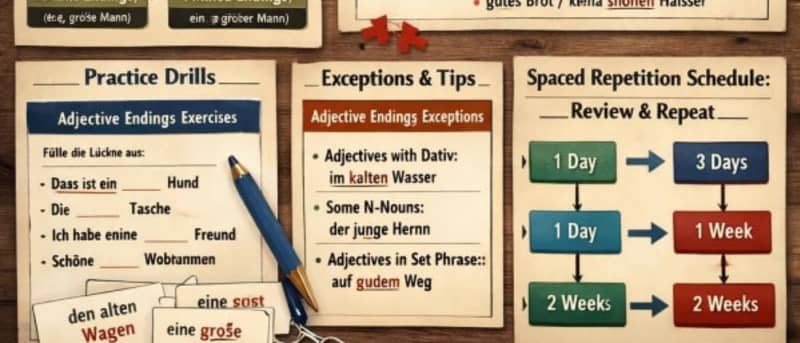
The core tool of this master plan is a decision tree printed on A3 paper. Place it near your study space or import the interactive version onto your tablet. The tree begins with three questions:
- Is there a determiner in front of the adjective? If no, go to the strong branch. If yes, proceed to Question 2.
- Is the determiner „der-word“ (der, die, das, dieser, jener, jeder, welcher, solcher, mancher)? If yes, choose the weak branch. If no, continue.
- Is the determiner „ein-word“ (ein, kein, mein, dein, sein, ihr, unser, euer, Ihr) or a quantity word like kein? If yes, choose the mixed branch. For partial determiners like viel, wenig, there is a special branch explained in Section 7.
The tree then guides you to the correct case column by asking „What role does the noun play in the sentence?“ Each branch ends with a box showing the ending for masculine, feminine, neuter, plural. Example: Strong declension, accusative, masculine → -en. This reduces the need to memorize entire tables because you follow the logic each time until the pattern becomes automatic.
Print version features color-coded paths (blue for strong, red for weak, green for mixed) and icons representing typical contexts (shopping bag for accusative objects, handshake for dative recipients, puzzle piece for genitive relationships).
4. Strong Declension: When No Article Leads the Way
Strong declension appears when adjectives stand alone without determiners, often in plural or uncountable contexts, after adverbs like viel (when used without article), or when emphasising distinctions: Frisches Brot ist besser als altes.
Strong endings mimic the definite article endings for case and gender because the adjective now carries the full load of identifying the noun. Use this table for quick reference:
| Case |
Masculine |
Feminine |
Neuter |
Plural |
| Nominative |
-er |
-e |
-es |
-e |
| Accusative |
-en |
-e |
-es |
-e |
| Dative |
-em |
-er |
-em |
-en + n on noun |
| Genitive |
-en |
-er |
-en |
-er |
Usage examples:
- Ich trinke gern kaltes Wasser. (neuter nominative)
- Wir suchen frische Ideen. (plural accusative)
- Mit rotem Wein kocht sie selten. (masculine dative)
- Aufgrund neuer Vorschriften müssen wir das Projekt anpassen. (plural genitive)
Practice drill: Write a restaurant menu without articles (e.g., „Hausgemachte pikante Suppe“). Record yourself reading the menu aloud to consolidate endings.
5. Weak Declension: Definite Article Guidance
Weak declension occurs when a definite determiner already signals case, gender, number. The adjective then takes simplified endings: mostly -e in nominative/accusative singular (except masculine accusative becomes -en) and -en everywhere else.
| Case |
Masculine |
Feminine |
Neuter |
Plural |
| Nominative |
-e |
-e |
-e |
-en |
| Accusative |
-en |
-e |
-e |
-en |
| Dative |
-en |
-en |
-en |
-en + n on noun |
| Genitive |
-en |
-en |
-en |
-en |
Remember that weak declension uses der-words: dieser, jener, jeder, welcher, mancher, solcher. Pronouns like alle also take weak endings on following adjectives in plural: alle wichtigen Termine.
Practice idea: Compose an office policy memo using definite articles for clarity. Example: Die neuen internen Richtlinien gelten für alle externen Partner. Check that your adjectives mostly end with -e or -en as appropriate.
6. Mixed Declension: Indefinite Articles and Possessives
Mixed declension applies when an ein-word (including possessives and kein) precedes the adjective. In these cases the article signals some information (gender/number) but lacks full case marking in nominative masculine and neuter, and accusative neuter. The adjective must supply the missing clues.
| Case |
Masculine |
Feminine |
Neuter |
Plural |
| Nominative |
-er |
-e |
-es |
-en |
| Accusative |
-en |
-e |
-es |
-en |
| Dative |
-en |
-en |
-en |
-en + n on noun |
| Genitive |
-en |
-en |
-en |
-en |
Key reminders:
- Mein neuer Kollege (nominative masculine) – adjective takes -er.
- Mein neuen Kollegen (accusative masculine) – adjective takes -en.
- Keine interessanten Fragen (plural) – adjectives in plural with kein use -en.
- Possessive adjectives behave identically: Unsere fröhliche Tochter, unseren fröhlichen Sohn.
Drill suggestion: Write a family description using possessive pronouns for at least eight different nouns. Highlight each ending and recite aloud until natural.
7. Special Determiners and Quantifiers (kein, solcher, viel, wenig)
Determiners like viel, wenig, mehr, etwas, manch, solch behave variably depending on whether they appear with endings themselves. When they show endings (e.g., viele), the following adjective takes weak endings. When they appear without endings (e.g., viel), the adjective takes strong endings.
Examples:
- Viele interessante Projekte – viele has ending, adjective → weak (-en).
- Viel interessantes Projektmaterial – viel without ending (usually singular mass noun), adjective → strong (-es).
- Solch ein schönes Haus – solch + ein triggers mixed declension (-es for neuter).
- Manch guter Rat – archaic/formal use; manch with singular noun uses strong endings for emphasis.
For negative determiner kein, treat it like ein (mixed declension). The decision tree includes a branch labeled „kein/possessive.“
Practice: Create sentences comparing quantities: Wenig zuverlässige Daten, wenige zuverlässige Daten (note shift from mass to count). Reflect how the ending modifies meaning.
8. Adjectives After Numbers, Pronouns, and Maßangaben
Numbers and measurement expressions follow distinct patterns:
- Cardinal numbers above one: behave like plural nouns without article. After „zwei/drei/vier...“ the adjective uses strong plural endings: zwei große Zimmer, drei offene Fragen.
- „Einer/eins/eine“: functions like ein, so mixed declension applies: eine spannende Aufgabe.
- Fractions and percentages: often use von + Dativ structure, with adjective matching the noun after von: 70 Prozent der befragten Studierenden.
- Pronouns such as „dieses“, „jenes“: treat as der-words leading to weak endings.
- Expressions with alles, nichts, etwas: When followed by adjective + noun, the adjective typically takes strong endings: etwas Wichtiges (note that the noun can be omitted, leaving adjective with capital letter functioning substantively).
Measurement phrases combine adjective endings with case-specific structures: einen Meter tiefe Grube (accusative), einer Stunde langer Spaziergang (genitive). The cheat sheet includes templates for crafting such sentences.
9. Exceptions, Irregularities, and High-Frequency Collocations
While the decision tree covers most scenarios, some expressions require memorization:
- Nationality adjectives used as nouns: der Deutsche, die Deutsche follow weak declension when used substantively with articles. Without articles they take strong endings: Deutsche trinken gern Kaffee.
- Fixed phrases: am besten (superlative with „am“ + dative), im Allgemeinen, im Voraus. These are idiomatic; treat them as set pieces even when they deviate.
- Color compounds: hellblaues Hemd, dunkelrote Jacke. The base color is treated as adjective; prefix remains unsuffixed. Decline the final element according to rules.
- Loan adjectives: lila, rosa and some brand adjectives remain invariable. Example: ein rosa Kleid (no ending). The cheat sheet lists invariable adjectives to avoid unnecessary endings.
- Words ending in -er from place names: Wiener Kaffee remains unchanged due to being derived from proper nouns, although in plural contexts some optional endings appear (die Wiener Kaffees).
A dedicated appendix compiles over 150 frequent adjective-noun collocations sorted by case for quick reference.
10. Register and Genre: How Adjective Endings Shift by Context
Different registers emphasize different adjective structures. In casual speech many Germans reduce adjectives, but in formal writing every ending counts. Understand the expectations:
- News articles: Frequent use of strong declension in headlines (Neuer Bundeskanzler verspricht). Body text uses weak endings with definite references (Der neue Bundeskanzler).
- Academic papers: Dense noun phrases with genitive chains: die im letzten Jahrzehnt beobachteten demografischen Veränderungen. Practice reading such structures to internalize endings.
- Business reports: Mixed declension with possessives: Unsere wichtigsten strategischen Ziele.
- Emails: Variation between formal and friendly tone affects definiteness. Compare „Vielen herzlichen Dank für Ihre schnelle Antwort“ vs. „Danke für die schnelle Antwort“.
Understanding register helps you adapt endings according to audience without sounding overly stiff or overly casual.
11. Visual Cheat Sheets: Printable Posters, Cards, and Slide Decks
Visual aids accelerate pattern recognition. The resource bundle includes:
- A1-sized wall poster: color-coded declension matrix mapping cases (columns) and declension types (rows). Each cell includes example sentences and icon clues.
- Flowchart cards: pocket-sized laminated cards summarizing the decision tree. Learners can clip them to note-taking journals.
- Slide deck: for teachers/trainers, with animated steps guiding learners through sample sentences. Each slide toggles endings to demonstrate transformation.
- Cloze worksheet pack: 10 printable worksheets with increasing difficulty, pairing with answer keys and QR codes linking to audio versions.
- Mind map template: encourages learners to map adjectives by semantic fields (e.g., beruflich, emotional, technisch) while filling endings.
Print on sturdy paper or load onto tablets for digital annotation. Teachers can assign specific cheatsheets as homework reinforcement.
12. Diagnostic Benchmark: Assessing Your Starting Point
Start with the 30-item diagnostic test included in the PDF bundle. It covers written fill-ins, sentence reordering, and short dictation. Score interpretation:
- 25–30 correct: near-automatic control; focus on idioms and speed.
- 18–24 correct: strong foundation but inconsistent with mixed declension; follow the eight-week plan carefully.
- 10–17 correct: revisit decision tree steps and practice with guided worksheets.
- 0–9 correct: strengthen case understanding before tackling advanced drills. Use Section 2 resources.
Retake the benchmark after four weeks and again after completing the eight-week plan to quantify progress. Log results in the progress dashboard template.
13. Drill Lab: Writing, Speaking, and Listening Workouts
This section supplies structured practice loops.
13.1 Writing Drills
- Transformation exercises: Convert short sentences by swapping determiners. Example: Der neue Vertrag ist wichtig. → Ein neuer Vertrag ist wichtig. → Wichtiger Vertrag ist selten.
- Paragraph rebuild: Take a paragraph with missing endings. Insert correct forms, then rewrite using synonyms to maintain endings under lexical change.
- Error spotting: Analyze intentionally flawed texts to identify incorrect endings, explain reasons, and correct them.
13.2 Speaking Drills
- Picture descriptions: Describe complex images (office scenes, cityscapes). Focus on noun phrases with adjectives: Im modernen, hellen Konferenzraum sitzen drei aufmerksame Teilnehmer.
- Role-play interviews: One learner acts as recruiter, the other as candidate. Recruiter prompts require adjectives in varying cases: Erzählen Sie mir von einem erfolgreichen internationalen Projekt.
- Speed rounds: Timer-based challenge where learners must produce five noun phrases under 30 seconds following assigned case/determiner combos.
13.3 Listening Drills
- Dictation tracks: Audio files with B1/B2 level news summaries. Pause after each sentence to write phrases, focusing on endings.
- Shadowing scripts: Repeat after native speaker audio to internalize rhythm of endings.
- Gap-fill podcasts: Provided transcripts with blanks for adjective endings; learners listen and fill them in.
Record your outputs, compare with answer keys, and note repeated mistakes in the error log from Section 19.
14. Spaced Repetition Calendar: 8-Week Retention Strategy
Adjective endings require regular revisit. The 8-week calendar ensures new patterns stick:
- Week 1: Learn the decision tree, complete diagnostic, create flashcards with 20 noun phrases per declension type.
- Week 2: Daily 15-minute review sessions using active recall. Alternate strong/weak/mixed focus days.
- Week 3: Introduce audio drills twice per week. Use spaced repetition software (Anki) with custom deck included.
- Week 4: Midpoint evaluation; adjust deck difficulty. Integrate writing prompts from Section 13.
- Week 5: Add context-based tasks (emails, reports). Implement „Friday review“ summarizing learned patterns.
- Week 6: Peer feedback session or AI tutor prompts to test spontaneous usage.
- Week 7: Simulate exam tasks under timed conditions. Compare results with Week 1 diagnostic.
- Week 8: Consolidation: create your own cheat sheet or teach a study partner. Teaching is the ultimate spaced repetition.
Each week includes restful days to avoid burnout. Check off completed tasks in the provided calendar PDF.
15. Error Clinic: Fixing Fossilized Mistakes with Targeted Interventions
Long-term learners develop persistent mistakes. The clinic offers treatments:
- Confusing mixed vs. weak endings: Diagnose by analyzing sentences with possessives. Write minimal pairs: mein neuer Chef vs. der neue Chef. Record yourself reading both and highlight differences.
- Plural dative -en + noun -n : Many learners forget to add n to the noun. Use the „Double N“ checklist: if adjective ends with -en in dative plural, ensure the noun also carries -n unless the noun already ends with n/s.
- Genitive masculine/neuter article duplicates: Use rhyme „Des guten Weins wegen“ to remember -en ending.
- Invariable adjectives confusion: Create a flashcard deck with images representing rosa, lila, orange as uninflected. Drill them separately.
- Overgeneralizing -e endings: Some learners plateau at A2 patterns (der große Mann, but mistakenly den große Mann). Practise case conversion tables daily until automatic.
Use the error log template to record mistake type, sentence, correction, and remediation action. Review logs weekly to monitor improvements.
16. Exam Integration: Goethe, TELC, TestDaF, DSH Expectations
Exam rubrics emphasize accuracy. Here is how each exam treats adjective endings:
- Goethe B2: In written tasks, consistent adjective endings contribute to „Sprachliche Richtigkeit“. Examiners note errors reducing clarity. Example writing prompt: Berichten Sie über einen gelungenen Urlaub. Evaluate sample answer with underlined endings.
- Goethe C1/C2: Expect dense noun phrases. Practise academic summaries with genitive chains. Example: Die im aktuellen Bericht dargestellten makroökonomischen Trends.
- TELC B2/C1 Business: Business correspondence tasks expect professionalism. Provide checklists for polite phrases: Für Ihr freundliches Schreiben danken wir Ihnen herzlich.
- TestDaF: Written production includes describing graphs. Ensure adjective endings align with quantities: die deutlich gestiegene Zahl der Bewerber.
- DSH: University contexts demand genitive and participial constructions. Practise rewriting research summaries focusing on endings.
Section includes exam-style tasks with answer keys annotated to show scoring criteria.
17. Professional Contexts: Business, Academia, Creative Writing
Beyond exams, real-world contexts require nuance:
17.1 Business Communication
Customers and colleagues expect precise language. Compose proposals with adjectives tied to metrics: unsere nachhaltig produzierten Verpackungslösungen. Provide templates for reports, meeting minutes, and negotiation summaries.
17.2 Academic and Scientific Writing
University assignments often contain stacked adjectives: die methodologisch fundierte empirische Studie. Use the provided academic phrasebank to combine adjectives and maintain endings.
17.3 Creative Writing
In fiction, adjectives add flavor but must still decline correctly. Exercises include rewriting fairy tales and urban stories with descriptive noun phrases. Example: Die flackernde, windgepeitschte Laterne beleuchtete den verlassenen Hof.
Each sub-section includes sample texts with commentary.
18. Teacher Toolkit: Lesson Plans, Group Games, Assessment Rubrics
Educators can deploy this master plan in classrooms or corporate training:
- Lesson sequences: 6 x 90-minute plans covering introduction, mixed practice, error correction, production tasks, and assessments. Each includes warm-up, main activities, and homework suggestions.
- Group games: „Declension Dominoes“ (match determiners, adjectives, nouns), „Grammar Escape Room“ (solve adjective puzzles to unlock clues), „Relay writing“ (teams complete sentences with correct endings under time pressure).
- Rubrics: B1 and B2 assessment rubrics aligning with CEFR descriptors. Criteria include accuracy, complexity, and self-correction ability.
- Feedback scripts: Example teacher comments focusing on endings („Achte darauf, im Dativ Plural das -n an den Nomen anzufügen.“).
- Hybrid/online adaptation tips: Use breakout rooms, collaborative whiteboards, and polls to keep learners engaged.
Teachers can customize templates for their institutional branding or LMS platforms.
19. Self-Assessment Templates and Progress Dashboards
Track improvement with structured tools:
- Weekly checklist: Rate confidence in strong/weak/mixed categories (scale 1–5). Note contexts causing hesitation.
- Progress dashboard: Spreadsheet with formulas calculating accuracy percentages from quiz results, autogenerating charts.
- Error log: Table with columns: „Sentence“, „Error Type“, „Correct Form“, „Strategy“, „Date Resolved“.
- Reflection journal prompts: „Welche Adjektivendung war diese Woche neu?“, „Welche Strategie hat am besten funktioniert?“
- Celebration tracker: Log milestones (first error-free essay, exam score improvements) to maintain motivation.
These templates exist in printable PDF and editable spreadsheet formats.
20. FAQ: Common Questions Answered with Examples
Warum gibt es drei Deklinationstypen?
Historisch trugen Artikel und Adjektive beide Kasusinformationen. In der modernen Sprache teilt sich die Arbeit: Wenn der Artikel bereits Kasus markiert, übernimmt das Adjektiv schwache Endungen; fehlt die Markierung, muss das Adjektiv stark flektieren. Gemischte Deklination schließt die Lücken.
Muss ich Tabellen auswendig lernen?
Tabellen sind hilfreich, doch der Entscheidungsbaum macht das System anwendbar. Übe mit dem Baum, bis du den Ablauf im Kopf hast. Danach brauche es kaum noch Nachschlagen.
Wie gehe ich mit zusammengesetzten Adjektiven um?
Nur das letzte Element trägt die Endung: ein dunkelblauer Mantel. Bei Partizipien gilt Gleiches: die gut trainierten Athleten.
Was ist mit substantivierten Adjektiven?
Wenn das Nomen fehlt, wird das Adjektiv großgeschrieben und weiterhin dekliniert: die Reichen (schwach), Reiches (stark). Benutze die gleichen Regeln wie bei Adjektiven vor Nomen.
Wie kann ich mich selbst korrigieren?
Nutze die Fehler-Checkliste: Lies Texte laut vor und stoppe bei jeder Adjektivgruppe. Frage: Welcher Artikel? Welche Funktion? Stimmen Endung und Nomen überein? Markiere unsichere Stellen zur späteren Überprüfung.
21. Linked Follow-Up Resources
Conclusion & Action Checklist
You now have a comprehensive framework for mastering German adjective endings. Consolidate your results with these steps:
- Print the decision tree and cheat sheets; keep them visible during study sessions.
- Follow the eight-week spaced repetition calendar and log your progress.
- Complete drill lab tasks weekly, alternating between writing, speaking, and listening.
- Review the error clinic after each assessment to target weak points.
- Share your newly created cheat sheet or teaching video with peers—teaching reinforces mastery.
With consistent application, adjective endings become automatic. You will write with confidence, speak without hesitation, and interpret complex German texts with ease. Continue refreshing the system every few weeks, and your accuracy will remain exam-ready and professionally convincing.
Official sources & references
Authoritative grammar, exam, and reference sources cited in this guide. All links verified.