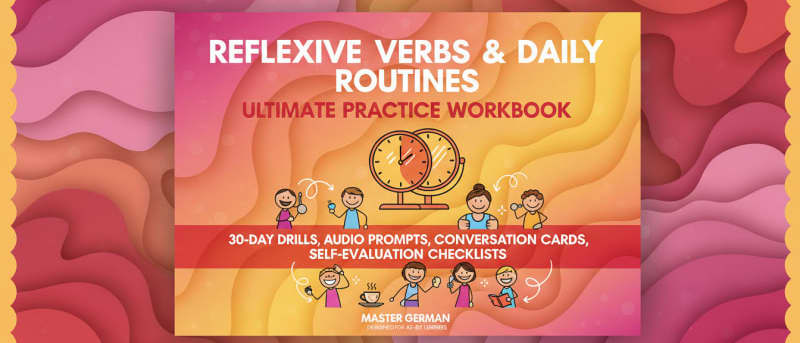
Master German Reflexive Verbs: Daily Routine & Free 2026 Worksheet
Reflexive verbs unlock fluency in everyday German. They help you describe everything from your morning habits to your evening self-care routine. This workbook transforms reflexive verbs from confusing grammar lists into living language you use throughout the day. You will learn the core reflexive structures, master daily routine vocabulary, build automation through 30-day practice drills, and reflect on progress with self-evaluation tools.
Who this workbook is for: A2–B1 learners who want to sound natural when talking about routines, responsibilities, wellness habits, and emotions. It is also perfect for busy professionals who require structured, bite-sized practice sessions and for teachers looking for ready-to-print classroom materials.
Table of Contents
1. Introduction: Why Reflexive Verbs Matter
In German, reflexive verbs help describe actions you perform on yourself or for yourself. They appear in daily routines (Ich wasche mich.), in emotional states (Ich freue mich.), and in idioms (Sich Mühe geben, to put in effort). Mastering them gives you control of personalized storytelling in German.
Reflexive verbs also build bridges to higher-level grammar: they prepare you for complex sentence structures, subordinate clauses, and modal verb combinations. This workbook integrates grammar with life contexts so you can practice reflexive verbs when talking about work, family, fitness, and relaxation.
2. Grammar Basics: Reflexive Pronouns & Cases
German reflexive verbs require reflexive pronouns. The pronoun agrees with the subject and can be accusative or dative depending on the verb and sentence structure.
2.1 Reflexive Pronoun Table
| Person |
Accusative |
Dative |
| ich |
mich |
mir |
| du |
dich |
dir |
| er/sie/es |
sich |
sich |
| wir |
uns |
uns |
| ihr |
euch |
euch |
| sie/Sie |
sich |
sich |
2.2 Accusative vs. Dative Reflexive
Most reflexive verbs take the accusative pronoun (Ich entspanne mich.). Some require dative when there is also a direct object: Ich wasche mir die Hände. In this sentence, die Hände is the direct object, so the reflexive pronoun is dative (mir).
2.3 Separable & Inseparable Prefixes
Many reflexive verbs include prefixes:
- Separable: sich ausruhen → Ich ruhe mich aus.
- Inseparable: sich entspannen → Ich entspanne mich.
Watch for word order changes in subordinate clauses and with modal verbs: weil ich mich ausruhen möchte, Ich muss mich beeilen.
3. Core Reflexive Verbs for Daily Routines
Start with the high-frequency verbs you need to describe your day. The table below lists essential verbs with sample sentences.
| Verb |
Meaning |
Example Sentence |
| sich waschen |
to wash oneself |
Ich wasche mich jeden Morgen um sechs Uhr. |
| sich anziehen |
to get dressed |
Er zieht sich vor der Arbeit schnell an. |
| sich ausziehen |
to undress |
Nach dem Sport ziehe ich mich aus. |
| sich duschen |
to shower |
Sie duscht sich abends, um zu entspannen. |
| sich kämmen |
to comb |
Ich kämme mir die Haare vor dem Meeting. |
| sich rasieren |
to shave |
Er rasiert sich jeden zweiten Tag. |
| sich beeilen |
to hurry |
Wir beeilen uns, um den Bus zu erwischen. |
| sich vorbereiten |
to prepare (oneself) |
Sie bereitet sich auf die Präsentation vor. |
| sich ausruhen |
to rest |
Nach der Arbeit ruhe ich mich eine halbe Stunde aus. |
| sich entspannen |
to relax |
Er entspannt sich mit Musik. |
Download printable flashcards for these verbs in the Appendix. Each card includes conjugation practice, a picture prompt, and a mini-dialogue exercise.
4. Beyond Basics: Emotions, Wellness, Workflows
Reflexive verbs extend beyond hygiene.
- Emotions: sich freuen (über/auf), sich ärgern, sich wundern.
- Wellness: sich ernähren, sich erholen, sich beruhigen.
- Work routines: sich anmelden, sich einloggen, sich konzentrieren, sich Notizen machen.
Introduce prepositional patterns: sich freuen auf (future events) vs. sich freuen über (current or past events). Provide multiple contexts to reinforce usage.
5. Daily Routine Vocabulary Builder (Morning to Night)
Build a daily timeline with reflexive verbs and collocations.
5.1 Morning Routine (6:00–9:00)
- Wachen: Ich wache um 6 Uhr auf.
- Stretching: Ich strecke mich und atme tief durch.
- Hygiene: Ich wasche mir das Gesicht., Ich putze mir die Zähne.
- Frühstück: Ich bereite mir einen Kaffee zu., Ich mache mir ein gesundes Frühstück.
- Planung: Ich setze mich an den Küchentisch und erstelle mir eine Tagesliste.
5.2 Workday Routine (9:00–17:00)
- Check-in: Ich logge mich in das System ein.
- Meetings: Ich bereite mich auf das Teammeeting vor.
- Focus: Ich konzentriere mich auf wichtige Aufgaben.
- Breaks: Ich gönne mir eine Pause., Ich hole mir einen Kaffee.
- Stress management: Ich erinnere mich daran, tief durchzuatmen.
5.3 Evening & Night (17:00–23:00)
- Family time: Ich kümmere mich um meine Familie.
- Exercise: Ich halte mich mit Yoga fit.
- Reflection: Ich nehme mir Zeit, den Tag zu reflektieren.
- Relaxation: Ich entspanne mich mit einem Buch., Ich mache es mir gemütlich.
- Sleep prep: Ich bereite mich aufs Schlafengehen vor., Ich stelle mir den Wecker.
Use the timeline worksheet to map your own daily routine with reflexive verbs and time expressions. Compare morning vs. weekend routines.
6. Sample Dialogues & Conversation Cards
Dialogues help internalize structures. Practice with partners or record yourself reading both roles.
Dialogue 1: Morning Rush
Anna: Wann stehst du auf?
Lukas: Ich stehe um halb sieben auf, aber ich muss mich oft beeilen, weil ich den Zug nicht verpassen will.
Anna: Beeilst du dich auch beim Frühstück?
Lukas: Ja, ich mache mir nur einen Kaffee und nehme mir ein Brötchen mit.
Anna: Und wann entspannst du dich?
Lukas: Nach der Arbeit ruhe ich mich auf dem Sofa aus.
Conversation Cards
- Card A: Beschreibe deine Morgenroutine mit mindestens fünf reflexiven Verben.
- Card B: Wie bereitest du dich auf eine Präsentation vor?
- Card C: Was machst du, wenn du dich gestresst fühlst?
- Card D: Erzähl von deinem letzten Urlaubstag. Welche Routinen waren anders?
- Card E: Was gönnst du dir zur Entspannung?
Print the cards and use them for pair work or self-recorded speaking practice.
7. Audio & Shadowing Prompts
Listening and speaking simultaneously accelerate accuracy. Use the audio strategy:
- Listen: Play the recorded routine once.
- Shadow: Repeat sentences immediately after you hear them.
- Record: Record yourself and compare to the original.
- Adjust: Focus on pronunciation of reflexive pronouns and sentence stress.
Suggested audio resources: DW Audio-Trainer (daily routines), podcasts like „Easy German“ episodes on habits, and textbook audio libraries.
8. Writing Prompts & Journaling Calendar
Writing consolidates grammar. Use the 14-day journaling calendar to practice longer sentences:
- Day 1: Beschreibe deinen Morgen in fünf Sätzen.
- Day 2: Schreibe über deine Mittagspause.
- Day 3: Welche Gewohnheit möchtest du dir angewöhnen?
- Day 4: Wie erholst du dich nach einem langen Tag?
- Day 5: Schreibe eine Schritt-für-Schritt-Anleitung für deine Workout-Routine.
- Day 6: Erkläre, wie du dich auf Prüfungen vorbereitest.
- Day 7: Rückblick auf die Woche – Was hat gut funktioniert?
- Day 8–14: Wiederhole Themen, addiere neue Reflexive, experimentiere mit verschiedenen Zeiten.
Include partner feedback by swapping journal entries and highlighting reflexive structures.
9. 30-Day Reflexive Verb Drill Program
The drill program builds muscle memory. Each week focuses on a theme, with daily micro-tasks taking 10–15 minutes.
Week 1: Morning Foundations
- Day 1: Flashcard sprint – repeat core verbs 5 times each.
- Day 2: Write a 10-sentence morning routine story.
- Day 3: Record yourself narrating the story.
- Day 4: Convert statements into questions (Wie beeilst du dich?).
- Day 5: Add time expressions (um halb acht, nach dem Frühstück).
- Day 6: Partner interview exercise.
- Day 7: Weekly review quiz with self-check.
Week 2: Work & Productivity
- Focus on verbs like sich konzentrieren, sich organisieren, sich entscheiden.
- Create a meeting script using reflexive verbs.
- Practice separation of prefix verbs in present, perfect, and future.
Week 3: Wellness & Emotions
- Write about self-care routines (Ich gönne mir ...).
- Combine reflexive verbs with modal expressions (Ich sollte mich mehr bewegen.).
- Use small talk scenarios to practice expressing feelings.
Week 4: Integration & Challenge
- Daily speaking challenge: 5-minute monologue each day.
- Record podcasts or vlogs about your routine.
- Prepare for exam-style tasks: rewrite active sentences in reflexive form.
- Complete final worksheet with translation tasks and gap fills.
10. Role-Plays, Games, and Partner Work
Practice speaking with interactive activities:
- Role-play: „Erster Tag im neuen Büro“ – introduce yourself, describe your routine.
- Game: Reflexive bingo – fill a grid with verbs; mark when you hear them.
- Speed rounds: One partner names a time, the other responds with a reflexive sentence.
- Problem-solving: Create a plan for a stressful day using calming reflexive verbs.
11. Self-Assessment & Progress Checklists
Track your improvement with formative assessments:
- Weekly checklist: Can you narrate your morning? Use reflexive verbs with time expressions? Explain feelings?
- Pronunciation log: Note difficult words (sich beeilen, sich erinnern).
- Error tracker: Record mistakes (wrong pronoun, missing prefix) and correct them.
- Confidence scale: Rate comfort level from 1–5 for each context.
Use the downloadable evaluation sheet to summarize progress at Weeks 2 and 4.
Teachers can adapt the workbook for group settings:
- Print the conversation cards for pair activities.
- Use listening prompts as warm-up dictations.
- Assign different routine timelines to groups (students, nurses, freelancers) and compare.
- Integrate station rotation: grammar lab, speaking booth, writing corner.
- Leverage exit tickets: Students write one sentence with a new reflexive verb.
13. Appendix: Worksheets, Flashcards, Reference Tables
Access the resource library:
- Printable worksheets: Gap fills, sentence transformations, timeline exercises.
- Flashcard deck: Digital Anki and printable cards with audio QR codes.
- Reference tables: Verb lists sorted by theme, case usage overviews.
- Conversation card PDF: Ready-to-cut prompts for partners.
- Answer key booklet: Suggested answers, alternative phrases, teacher notes.
14. Linked Learning Paths & Next Steps
Build momentum with related guides:
15. FAQ: Common Reflexive Questions
Is every reflexive verb only reflexive?
No. Some verbs can be reflexive or non-reflexive depending on meaning. Ich wasche das Auto (non-reflexive) vs. Ich wasche mich (reflexive).
How do I know if the pronoun is accusative or dative?
If there is another direct object, the reflexive pronoun becomes dative. Otherwise, it is accusative. Practice with sentence transformations to internalize the pattern.
Do reflexive verbs exist in perfect and future tenses?
Yes. They conjugate like normal verbs with haben: Ich habe mich beeilt., Ich werde mich beeilen.
Can I use reflexive verbs in commands?
Yes. Example: Beeil dich!, Mach es dir gemütlich!, Entspann dich!
What if the subject is plural?
Use the matching reflexive pronoun: Wir freuen uns., Ihr beeilt euch., Sie setzen sich.
Conclusion & Action Plan
You now have a full toolkit to master reflexive verbs in German. Follow the 30-day drill program, use the conversation cards for speaking, and keep the checklists handy to monitor progress. Combine this workbook with regular exposure to German podcasts and videos for natural input.
Next steps: Download the resource pack, schedule daily micro-practice sessions, and track your progress weekly. Reflexive verbs will soon feel automatic, empowering you to narrate your life confidently in German.
Official sources & references
Authoritative level frameworks and practice sources cited in this guide. All links verified.