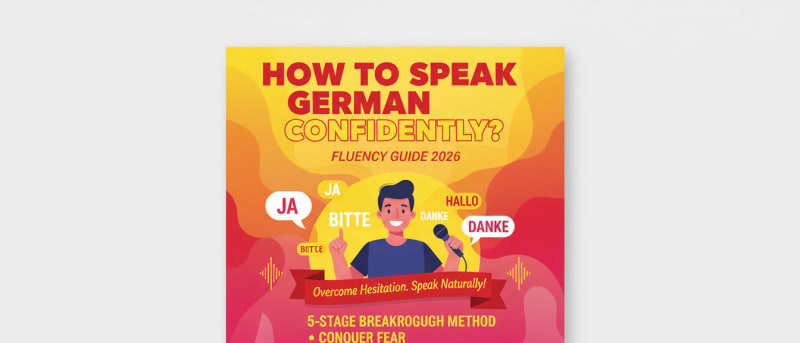
From Silent to Fluent in German: Your Complete Guide to Speaking Confidence
As a German speaking coach who has helped thousands of learners find their voice, I have seen one recurring pain point: many students understand German perfectly well but freeze when it is time to speak. They know the grammar, memorise vocabulary, and follow every rule, yet when a German speaker looks at them, their mind goes blank. If that is you, this guide is for you.
The Reality: Speaking confidence is a skill, not a personality trait. You do not wait for confidence to arrive; you build it step by step. With the right structure, daily habits, and mindset shifts, you can move from silence to fluent, natural conversations faster than you imagine.
What You Will Learn in This Guide
- Why hesitation happens and how to break the freeze response
- The 5-Stage Speaking Breakthrough Method with timelines and daily actions
- Mindset strategies that keep you consistent when fear appears
- Practical routines to expand vocabulary for spontaneous speech
- How to use shadowing, role plays, and self-talk effectively
- Conversation blueprints for predictable, real-life situations
- The 70% Rule and why waiting for perfection blocks fluency
- Tracking systems that show real progress every single week
Breaking the Speaking Barrier
Every learner who struggles to speak faces a combination of four blockers. Once you identify your blockers, you can apply targeted solutions.
Why We Hesitate to Speak
- Fear of mistakes: Worrying about embarrassing yourself or being judged.
- Perfectionism: Wanting to deliver every sentence flawlessly before you even start.
- Limited active vocabulary: Knowing words passively but not retrieving them fast enough.
- Slow processing: Translating in your head and missing your chance to reply.
- Silent habit: Not speaking enough, so your brain defaults to silence when pressure appears.
Key Insight: Speaking confidence is developed through exposure. The more often you speak in low-risk situations, the easier it becomes to speak in high-pressure situations. You will not think your way to confidence; you will speak your way to it.
The 5-Stage Speaking Breakthrough Method
This method takes you from complete silence to spontaneous conversation over 9+ weeks. Each stage builds on the previous one, so do not skip ahead. Stay in a stage until you complete the daily actions comfortably.
Stage 1: Self-Talk (Week 1-2)
Goal: Activate your mouth and brain in German without pressure.
Daily Actions (10-15 minutes):
- Narrate your morning routine: “Jetzt mache ich Kaffee. Ich suche meine Tasse.”
- Describe objects around you: colours, size, function.
- Think out loud during chores; keep sentences simple and continuous.
- Use mirror practice: make eye contact with yourself to simulate a listener.
- Record one 60-second voice memo every day; no need to re-listen yet.
Mindset Anchor: Speed does not matter. Your priority is to keep talking without switching to English.
Stage 2: Structured Monologues (Week 3-4)
Goal: Speak about familiar topics for 2-5 minutes with basic structure.
Daily Actions (15-20 minutes):
- Choose one topic per day (hobbies, weekend plans, job, favourite film).
- Write a quick outline: introduction, three points, conclusion.
- Record yourself for 2-5 minutes following the outline.
- Listen back once and note: Where did I pause? Which words were missing?
- Add missing words to an “active speaking” vocabulary list.
Mindset Anchor: It is okay to pause and think. Structure helps you stay calm when you speak.
Stage 3: Shadowing (Week 5-6)
Goal: Train your ear and mouth to handle natural speed.
Daily Actions (15 minutes):
- Pick short audio (10-30 seconds) with transcript (Easy German, DW, podcasts).
- Listen once without speaking.
- Listen again while whispering along.
- Shadow the audio in real-time, matching rhythm and intonation.
- Repeat until you can stay in sync; aim for three successful repetitions.
- Finish by speaking the text from memory without audio.
Mindset Anchor: Shadowing is a workout. Feeling awkward is a sign that you are training new muscles.
Stage 4: Predictable Interactions (Week 7-8)
Goal: Handle low-pressure, real-world exchanges confidently.
Weekly Actions (60 minutes total):
- Role-play common scenarios: ordering coffee, buying train tickets, asking for directions.
- Create script templates with key phrases and polite fillers.
- Visit local German-speaking venues or call service hotlines.
- Note what worked and what felt uncomfortable; tweak scripts accordingly.
- Celebrate every micro-success—each interaction rewires your brain.
Mindset Anchor: Predictable interactions give you practice reps. Focus on clarity, not perfection.
Stage 5: Spontaneous Conversation (Week 9+)
Goal: Maintain conversations without scripts.
Weekly Actions (90 minutes total):
- Join language exchanges, German Meetups, or online conversation groups.
- Schedule 30-minute sessions with tutors or speaking partners.
- Use conversation starters: “Was war das Highlight deiner Woche?”
- Practice follow-up questions: “Erzähl mir mehr.” “Wie meinst du das genau?”
- After each session, summarise the conversation in a voice note.
Mindset Anchor: Conversations are co-created. Your job is to keep the exchange alive, not to deliver the perfect sentence.
The 70% Rule
Waiting until you feel “100% ready” keeps you silent. Commit to speaking when you feel 70% ready. This rule accelerates progress because:
- It removes the perfectionism trap.
- Real conversations highlight the vocabulary you truly need.
- Confidence grows from action; feedback from real situations is priceless.
Repeat daily: “70% ready is ready enough.”
Mindset Shifts for Confident Speakers
1. Mistakes Are Data, Not Drama
Every mistake shows you what to practice next. Track mistakes in a notebook, label them (grammar, vocabulary, filler words), and turn them into micro-goals.
2. Replace Negative Loops with Speaking Mantras
Before speaking, repeat: “I am here to communicate, not to perform.” “German speakers love my effort.” “Progress beats perfection.”
3. Visualise the Win
Spend 30 seconds visualising a successful interaction. See yourself smiling, speaking clearly, noticing the other person nodding.
4. Confidence Portfolio
Document every success story, no matter how small. Reviewed weekly, this portfolio rewires your brain to expect positive outcomes.
Vocabulary Strategies for Speaking
Fluent speakers do not know every word; they know how to use the words they already have. Use these strategies to activate vocabulary.
1. Build Topic Bundles
For each common topic (work, travel, hobbies), build a bundle:
- 10 core nouns
- 5 key verbs with conjugations
- 5 adjectives/adverbs to add colour
- 3 filler phrases (“Weißt du…”, “Ehrlich gesagt…”, “Lass mich nachdenken.”)
2. Activate Passive Vocabulary
Review your reading notes and highlight words you recognise but rarely use. Turn each into a sentence you can say out loud three times.
3. Phrase Transformation Drills
Take a basic sentence: “Ich habe gestern gearbeitet.” Expand it:
- Add detail: “Ich habe gestern acht Stunden im Homeoffice gearbeitet.”
- Add emotion: “Es war anstrengend, aber ich habe viel geschafft.”
- Add follow-up: “Danach habe ich mit meiner Kollegin über das Projekt gesprochen.”
Conversation Blueprints
Prepare for common situations with blueprints that include openings, follow-ups, and exits.
Ordering Coffee
- Opening: “Guten Morgen! Ich hätte gern einen Cappuccino zum Mitnehmen.”
- Clarify: “Könnten Sie ihn mit Hafermilch machen?”
- Small talk: “Ist es heute immer so voll hier?”
- Exit: “Danke schön! Einen schönen Tag noch.”
Networking Event
- Opening: “Hallo, ich bin Thomas. Was hat dich heute zu diesem Event gebracht?”
- Follow-up: “Spannend! Was ist deine Rolle im Unternehmen?”
- Share: “Ich arbeite als Produktmanager und lerne nebenbei Deutsch.”
- Exit: “Hat mich gefreut! Vielleicht sehen wir uns später wieder.”
Conversation Lifelines
Keep a shortlist of lifelines when you get stuck:
- “Wie sagt man das auf Deutsch?”
- “Ich versuche es anders zu erklären.”
- “Gib mir bitte eine Sekunde nachzudenken.”
- “Was denkst du darüber?”
Weekly Speaking Schedule
Use this sample schedule to maintain momentum once you reach Stage 5.
- Monday: 10 minutes self-talk + 10 minute shadowing.
- Tuesday: 20 minute tutor session (focus on role plays).
- Wednesday: Record a 5 minute monologue and review.
- Thursday: Attend language exchange or practice with partner.
- Friday: Review vocabulary list + phrase drills.
- Saturday: Real-life interaction (shop, café, meetup).
- Sunday: Reflection: What improved? What needs attention next week?
Measuring Your Speaking Progress
Progress tracking keeps you motivated and honest.
- Speaking Minutes: Track how many minutes you spoke this week.
- Confidence Score: Rate each speaking session from 1-5 (1 = nervous, 5 = relaxed).
- Mistake Log: Write down recurring issues and plan mini-drills.
- Celebration List: Record every positive feedback or successful conversation.
Common Speaking Myths (And the Truth)
- Myth: “Native speakers will be annoyed by my mistakes.”
Truth: Most German speakers appreciate your effort and gladly help.
- Myth: “I need more grammar before I speak.”
Truth: Speaking reveals which grammar points you actually need.
- Myth: “Listening and reading are enough.”
Truth: Passive skills help, but you only become fluent by producing language.
- Myth: “Confidence is natural. Some people just have it.”
Truth: Confidence is earned through repeated action.
Case Studies: From Hesitant to Confident
Seeing the method in action helps you believe it will work for you. Here are three real student journeys that followed this roadmap.
Case Study 1: Sara – A1 to Fluent Conversations in 12 Weeks
Sara moved to Berlin with basic German (A1). She could read menus but avoided speaking. We started with Stage 1 self-talk. By week 4 she recorded two-minute monologues about her workday. After eight weeks, she was ordering lunch and chatting with colleagues about weekend plans. Week 12: she joined a parent-teacher meeting and spoke for 15 minutes without switching to English. Her breakthrough moment? Realising that pausing to think is normal—even for natives.
Case Study 2: Ahmed – Engineer Preparing for German Job Interviews
Ahmed had strong technical German but froze when questions became personal. We doubled down on Stage 2 monologues and Stage 3 shadowing. He outlined common interview questions, recorded answers daily, and shadowed recordings from German recruitment podcasts. By interview week he could adapt answers on the fly and received two job offers. His biggest aha moment: “I do not need perfect grammar. I need honest stories and confident delivery.”
Case Study 3: Elena – From Silent Partner to Meetup Host
Elena loved Germany but avoided social events. We focused on Stage 4 predictable interactions—ordering, asking for help, small talk in cafés. She tracked every successful encounter in her confidence portfolio. Within three months she hosted a weekly language meetup, using the conversation blueprints from this guide. Her advice to other learners: “Celebrate micro-wins. Confidence is just evidence stacked over time.”
Your Turn: Choose one story above that resonates with you. Borrow their strategy and schedule it into your week.
Emergency Toolkit: What to Do When You Freeze
Even advanced speakers freeze sometimes. Use this toolkit to recover quickly.
- Reset Breath: Inhale through the nose for 4 counts, exhale through the mouth for 6 counts.
- Fallback Phrase: “Lass mich kurz überlegen.” (Buys you time.)
- Switch to paraphrasing: Explain the idea with simpler words.
- Ask a question: Return the conversation to the other person.
- Laugh it off: “Mein Deutsch ist noch nicht perfekt, aber ich übe jeden Tag.”
Putting It All Together
Fluency is not about sounding like a native speaker. It is about being understood, building connections, and expressing yourself without fear. Follow the 5-Stage Speaking Breakthrough Method, honour the 70% Rule, and track your progress weekly. In a few months, you will look back at your silent self and barely recognise them.
Start today: Choose your stage, set a timer for 10 minutes, and speak. Tomorrow, repeat. Your future fluent self is built one brave minute at a time.
Official sources & references
Authoritative learning and level sources cited in this guide. All links verified.