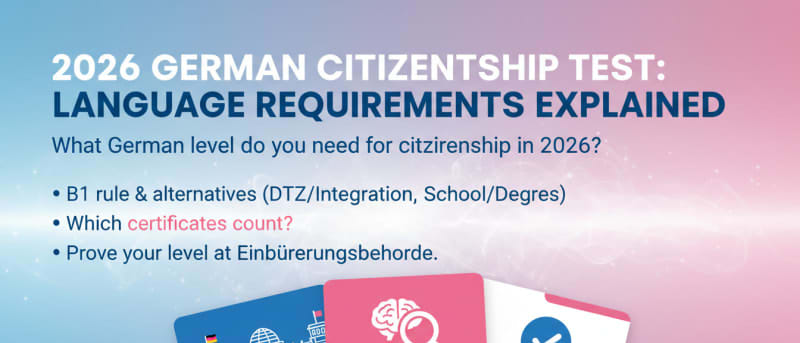
German Citizenship: What Language Level Do You Need? (2026)
When I started preparing my German citizenship paperwork, the language requirement was the part that confused me most. Everyone said “B1”, but then I heard exceptions, special fast-track rules, and stories of local offices rejecting certificates they considered “too old”. So I did what I always do: I read the official pages, compared what different authorities publish, and asked people who had recently submitted their application. This guide is the result. It explains the German citizenship language level 2026 rules, the real alternatives to a standard B1 exam, which certificates are accepted, and how to submit your proof without getting stuck in back-and-forth.
For the official legal framework (Staatsangehörigkeitsgesetz) and 2026 requirements, see the Federal Ministry of the Interior (BMI).
p>If you want to practise immediately, jump to our
German B1 practice tests and
learning resources. For law and policy updates, I also keep an eye on our
news page.
2026 Citizenship Language Rules
Standard requirement: In 2026, the default language requirement for naturalization is CEFR level B1. In practical terms, B1 means you can understand the main points of clear standard German on familiar matters, handle most everyday situations, and produce simple connected text about topics you know.
2026 context: Under the modernized Staatsangehörigkeitsgesetz (StAG), the standard residence requirement is generally reduced (often discussed as 5 years for standard cases) and the fast-track route can be 3 years with “special integration achievements”. The language level and your integration evidence work together. This is why I recommend treating language as the “cleanest” part of your application: it is one of the easiest requirements to prove with a clear certificate.
Fast-track (3 years): The fast-track route is usually linked to stronger integration evidence. In many official summaries, C1 is the level that commonly appears alongside “special integration achievements” (for example: consistent voluntary work, strong professional performance, or exceptional integration). The safest move I saw people make was to check the official guidance from the BMI and their local office before assuming C1 is mandatory for every fast-track scenario.
B1 and Other Options (Alternatives & Exemptions)
This is the part most people miss. You don't always need a standalone B1 exam if you already have qualifying education in Germany or an accepted integration certificate. Here are the alternatives I kept seeing in official checklists and real applications:
Educational proof (often accepted)
- German school completion: A German school-leaving certificate can count as language proof (many offices accept this as stronger evidence than B1).
- German-taught degree: A German university degree (or Fachhochschule) where German was the language of instruction is commonly accepted.
- German vocational training: A completed German Berufsausbildung is often accepted as proof of language competence.
- School progression: Some offices accept proof of progression in a German-speaking school (for example advancement to higher grades), depending on your case.
Integration course (DTZ / Zertifikat Integrationskurs)
If you completed an integration course, the Zertifikat Integrationskurs (usually tied to the DTZ) can serve as official language proof. This is one reason so many people take the integration pathway: it bundles language + orientation requirements in one recognized framework. If you need a DTZ-specific overview, see our DTB/DTZ BAMF guide.
Exemptions (hardship / special groups)
- Hardship clause: If someone has a physical, mental, or psychological disability (or an age-related inability to learn), an exemption can apply, typically requiring medical evidence.
- Gastarbeiter / Vertragsarbeiter: Some applicants from these groups may have different proof expectations (often more “oral communication” focused). If this could apply to you, I would not guess—check the BMI guidance and your local office's checklist.
Which Certificates Count (Accepted Providers)
When I asked “which B1 certificate is accepted?”, the answer was consistent: use a recognized provider (often described as ALTE-aligned or officially listed) and you'll avoid problems. The certificates people most often use are:
- Goethe-Institut: Goethe-Zertifikat B1
- telc: telc Deutsch B1 (and for the integration pathway: DTZ)
- ÖSD: ÖSD Zertifikat B1
- Higher certificates: B2/C1/C2 certificates are generally accepted because they exceed B1 (but your local office may still check authenticity and “recency”).
Two practical notes I learned the hard way from other applicants:
- “Recency” varies by office: Legally, certificates typically don't “expire”, but some local offices may prefer more recent proof or may invite you for an additional interview if they doubt your current level.
- Don't submit attendance papers: A Teilnahmebescheinigung (attendance certificate) is not the same as an exam result. Offices usually want an exam certificate or a qualifying school/degree document.
For official reference points, I used the BAMF pages and the government portal Make it in Germany, because they are the clearest “public-facing” sources for migrants.
How to Prove Your Level (What to Submit)
In most cases you submit your proof to your local Einbürgerungsbehörde (citizenship office). Here's the approach that helped people I know avoid delays:
- Submit the right format: Bring the original certificate or a certified copy (beglaubigte Kopie), depending on what your office requests.
- Expect verification: Offices may verify authenticity via the provider's verification process or by checking the certificate details.
- Keep a clean file: If you have multiple documents (school, degree, DTZ, B1 exam), label them clearly and include only what supports your case.
Common mistakes I kept seeing: mixing up the Leben in Deutschland test (knowledge test) with the language requirement, submitting A2 when B1 is required, or assuming an old certificate will be accepted without question. The LiD/Einbürgerungstest is important, but it is not a language certificate.
Bonus: Chancenkarte (Opportunity Card) Language Rules & Points (2026)
You asked for a short, practical summary. The Chancenkarte is a points-based route where many applicants aim for 6 points (unless they qualify via a different recognized-professional pathway). In practice, language can be both an eligibility gate and a way to add points:
- Basic eligibility (common rule of thumb): applicants often need at least A1 German or B2 English to use the points-based route.
- German points (commonly cited bands): A1 = 1 point, A2 = 2 points, B1 = 3 points, B2+ = 4 points.
- Why this matters for citizenship planning: If you're already building German for visas (A1/A2/B1), that same progress also supports your longer-term citizenship plan. It's one learning path, just different paperwork goals.
If you're doing Chancenkarte planning, keep your documents consistent and always confirm the latest rules on Make it in Germany's Opportunity Card page and the official self-check tools.
FAQ
Do I need B1 for citizenship?
For most applicants, yes: B1 is the nationwide standard. Some people qualify via education in Germany (school/degree/vocational training), integration certificates (DTZ), or exemptions in hardship/special cases.
Which exams are accepted?
In practice, the most commonly accepted options are Goethe, telc, ÖSD, and the DTZ via the integration course. Higher certificates (B2/C1/C2) usually work as well, since they exceed B1.
Next Steps
If you're aiming for citizenship in 2026, my practical advice is: don't overthink the provider—pick the certificate you can realistically book and pass. Then document it cleanly for your local office. To prepare efficiently, use our B1 practice tests and learning resources, and follow updates in our news section.
CTA: Prepare with our B1 resources and build a clear, submit-ready language proof file.
Official sources & references
Authoritative links for citizenship language rules, integration certificates, and the legal framework mentioned in this guide.