Master German Pronunciation: Your Complete Teacher Guide
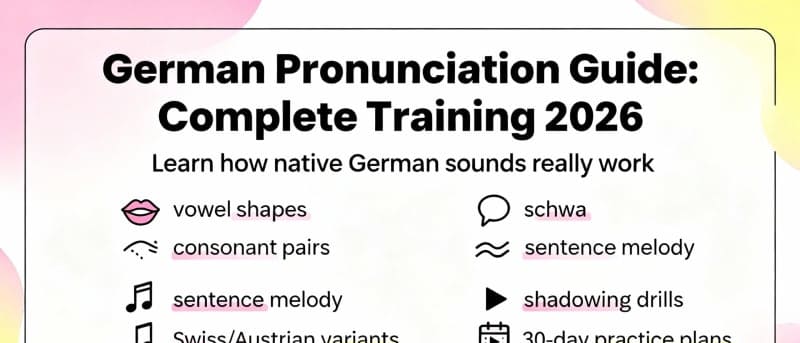
German pronunciation becomes simple when you learn how native speakers shape vowels, release consonants, and organise sentence melody. This 3000-word guide gives you the exact instructions I use in class: detailed explanations, mouth positions, minimal pairs, regional notes, shadowing scripts, and a 30-day practice plan that trains your ear and mouth until German sounds feel natural.
How to use this guide:
- Study the cheat sheets for vowels and consonants.
- Listen to curated audio resources while following the mouth-position diagrams.
- Shadow the dialogues and mini stories to build rhythm.
- Use the daily micro drills in the 30-day plan.
- Update your pronunciation journal weekly with feedback and breakthroughs.
Table of Contents
- 1. Vowel Blueprint: Short, Long, Umlauts
- 2. Consonant Mastery: From “ch” to “r”
- 3. Diphthongs & Double Letters
- 4. Syllable Stress, Sentence Melody, Word Linking
- 5. Regional Accents: Germany, Austria, Switzerland
- 6. Shadowing Scripts & Tongue Twisters
- 7. 30-Day Pronunciation Training Plan
- 8. Tech Tools, Self-Recording, and Feedback Systems
- 9. Quick Reference & Downloadables
1. Vowel Blueprint: Short, Long, Umlauts
German vowels are shaped pure (no glide) and can be short or long. Get these correct, and your German immediately sounds cleaner.
Short Vowels (Kurz)
| Vowel |
Sound |
Tip |
Example |
| a |
[a] like “u” in “cup” |
Jaw relaxed, tongue low |
„Mann“, „alle“ |
| e |
[ɛ] like “e” in “bed” |
Tongue mid-low |
„Bett“, „denken“ |
| i |
[ɪ] like “i” in “bit” |
Tongue high, lips unrounded |
„mit“, „finden“ |
| o |
[ɔ] like “o” in “gone” |
Lips medium round |
„offen“, „kommen“ |
| u |
[ʊ] like “u” in “put” |
Lips rounded, tongue high |
„und“, „Luft“ |
Long Vowels (Lang)
Long vowels are held about twice as long and often spelled with double letters or silent h.
| Vowel |
Sound |
Example |
Memory Hook |
| a |
[aː] like “a” in “father” |
„Tag“, „fahren“ |
Written aa or a + h |
| e |
[eː] between “hey” and “ay” |
„lesen“, „Meer“ |
Often “ee” or “eh” |
| i |
[iː] like “ee” in “see” |
„ihn“, „viele“ |
“ie”, “ih”, “i + silent h” |
| o |
[oː] like “o” in “go” |
„Brot“, „wohnen“ |
Double o or o + h |
| u |
[uː] like “oo” in “moon” |
„gut“, „Uhr“ |
“uh”, “u + silent h” |
Umlauts: ä, ö, ü
Umlauts change the vowel quality. The lips and tongue work together: short versions are clipped, long versions extended.
- ä / [ɛ] or [eː] – “äpfel” [ɛ], „spät“ [eː]. Shape mouth like [e] but drop jaw slightly for [ɛ].
- ö / [œ] or [øː] – Mix “eh” and “o”. Tongue mid-high, lips rounded. „schön“ [ʃøːn], „Löffel“ [ˈlœfəl].
- ü / [ʏ] or [yː] – Say “ee” with rounded lips. „über“ [ˈyːbɐ], „küssen“ [ˈkʏsən].
Minimal Pair Practice
Shadow these pairs. Record yourself and compare to native audio.
- schon vs. schön (already vs. beautiful)
- muss vs. müssen (must vs. to have to)
- Hut vs. Hütte (hat vs. hut)
2. Consonant Mastery: From “ch” to “r”
German consonants are crisp. Many errors come from English habits (aspirated stops, soft endings). Train these categories deliberately.
The “ch” Sounds: ich-Laut vs. ach-Laut
- ich-Laut [ç] – After front vowels (i, e, ä, ö, ü). Light hiss from the front of the mouth. „ich“, „Mädchen“, „Licht“.
- ach-Laut [x] – After back vowels (a, o, u). Stronger, from the back of the throat. „Bach“, „Buch“, „auch“.
- Practice: Alternate “milch – mach”, “Licht – Loch”, “ich – ach”.
The “r” Variants
- Initial r [ʁ] – Soft, voiced, uvular. „rot“, „Regen“.
- Medial r – After vowels often becomes a vowel-like sound [ɐ]. „Hörer“ → [ˈhøːʁɐ].
- Ending r – Usually [ɐ] or dropped in casual speech: „besser“ → [ˈbɛsɐ].
- Tip: Avoid English retroflex [ɹ]. Think “French r light”.
Final Devoicing (Auslautverhärtung)
At the end of a syllable, voiced consonants become voiceless: „Tag“ [taːk], „lieb“ [liːp]. To check, add a vowel: “Tage” [ˈtaːgə].
Stops: p, t, k vs. b, d, g
Keep them sharp. German p/t/k have minimal aspiration. Practice saying “p, t, k” without a puff of air; hold a tissue in front of your mouth to test.
3. Diphthongs & Double Letters
Diphthongs combine two vowels smoothly. Avoid adding extra syllables.
- ei / ai → [aɪ̯] like English “eye” – „mein“, „frei“
- eu / äu → [ɔɪ̯] like “oy” – „neu“, „Bäume“
- au → [aʊ̯] like “ow” – „Haus“, „blau“
Double consonants indicate short vowels: „mitten“, „Hütte“. Double vowels or silent h indicate long vowels.
4. Syllable Stress, Sentence Melody, Word Linking
Word Stress
- Most German words stress the first syllable: „Schule“, „Freundlich“.
- Prefix verbs: separable prefixes stressed („aufstehen“), inseparable prefixes unstressed („verstehen“).
- Compound nouns: stress the first element („Küchenmesser“).
Sentence Melody
German intonation sits between English and Spanish. Statements fall slightly at the end; yes/no questions rise.
- Statements: „Ich fahre morgen nach Berlin.“ → fall at “Berlin”.
- Yes/No questions: „Fährst du morgen nach Berlin?“ → rise at the end.
- W-questions: rise in the middle, fall at the end. „Wann kommst du?“
Linking & Reduction
Native speakers connect words: „Geht es“ → „Gehts“, „Hast du“ → „Hastu“. Recognise and practise these forms.
5. Regional Accents: Germany, Austria, Switzerland
Standard German (Hochdeutsch) is taught worldwide, but you will hear accent variations. Training your ear to recognise them reduces confusion.
Germany (Hochdeutsch)
- Clear distinction between ich-Laut and ach-Laut.
- Distinct umlauts.
- Sample resources: Deutsche Welle, Tagesschau, Easy German street interviews.
Austria
- Long vowels slightly softer: „Haus“ with more rounded “au”.
- „K“ sometimes pronounced like hard “g”.
- Common words: „Paradeiser“ (tomato), „Sackerl“ (bag).
Switzerland
- “ch” is velar [x] almost everywhere („ich“ → [ɪx]).
- “r” often rolled. Double consonants pronounced longer.
- Use of Swiss German words in daily speech; practise comprehension via SRF podcasts.
Tip: Add one regional resource per week to your listening schedule. Even if you speak Hochdeutsch, understanding accents builds fluency fast.
6. Shadowing Scripts & Tongue Twisters
Shadowing Script 1 – Morning Routine
„Guten Morgen! Ich stehe um sieben Uhr auf, mache mir einen Kaffee und öffne das Fenster. Danach dusche ich, ziehe mich an und fahre mit dem Fahrrad zur Arbeit.“
Shadowing Script 2 – Shopping Dialogue
Kundin: Entschuldigung, wo finde ich frisches Obst?
Mitarbeiter: Gleich hier links. Die Äpfel sind im Angebot.
Kundin: Perfekt, danke! Gibt es auch Bio-Gemüse?
Mitarbeiter: Ja, hinten rechts neben der Käsetheke.
Tongue Twisters
- ch-Laut: „Eichhörnchen essen köstliche Kirschen.“
- r rolling: „Brautkleid bleibt Brautkleid und Blaukraut bleibt Blaukraut.“
- Umlauts: „Fünf Flüchtlinge flohen früh zur Fähre.“
7. 30-Day Pronunciation Training Plan
Spend 15-20 minutes daily. Consistency beats intensity.
Week 1 – Vowel Foundations
- Day 1: Short vowels [a ɛ ɪ]
- Day 2: Long vowels [aː eː iː]
- Day 3: Umlauts ä/ö/ü minimal pairs
- Day 4: Diphthongs
- Day 5: Record & compare, note issues
- Day 6: Review + tongue twister
- Day 7: Rest or watch German TV
Week 2 – Consonant Clarity
- Day 8: “ch” drills
- Day 9: “r” variations
- Day 10: Final devoicing exercises
- Day 11: Stops without aspiration
- Day 12: Combine vowels + consonants
- Day 13: Shadow easy dialogue
- Day 14: Feedback session with tutor/friend
Week 3 – Rhythm & Intonation
- Day 15: Word stress drills
- Day 16: Sentence melody – statements
- Day 17: Questions & exclamations
- Day 18: Link words in short text
- Day 19: Shadow news clip (30 seconds)
- Day 20: Record a paragraph and self-evaluate
- Day 21: Dialect listening (Austrian or Swiss)
Week 4 – Real-World Application
- Day 22: Shadow a full conversation
- Day 23: Practice a phone call script
- Day 24: Present a 2-minute story out loud
- Day 25: Feedback session with tutor or native speaker
- Day 26: Audio journaling (describe your day)
- Day 27: Retell a news story using new vocabulary
- Day 28: Record before/after comparison
- Day 29: Celebrate progress, note areas to review
- Day 30: Plan next month’s maintenance routine
8. Tech Tools, Self-Recording & Feedback
- Forvo / Duden Aussprache – native audio of individual words.
- Praat – visualise your waveforms to compare stress and length.
- Speechling – daily pronunciation feedback from coaches.
- Anki – build a deck with IPA + audio + minimal pairs.
- Voice Journals: Record short entries daily. Label files by date to track progress.
Feedback Formula
- Record your attempt.
- Compare with native audio (split-screen method).
- Note differences in mouth shape, rhythm, or pitch.
- Repeat immediately; attach your improvement note in a journal.
- Send a weekly clip to a tutor or language partner for extra feedback.
9. Quick Reference & Downloadables
- PDF cheat sheet: vowel chart + mouth positions.
- Audio pack: minimal pairs, shadow scripts, tongue twisters.
- Pronunciation journal template.
- 30-day tracker printable.
- “Emergency phrases” pronunciation list for fast practice.
Conclusion: Speak German With Confidence and Clarity
Pronunciation unlocks everything: clearer conversations, easier listening, and more confidence when you speak. Follow the plan, repeat with intention, and your German will start sounding authentically German. Keep your journal updated, schedule weekly feedback, and revisit tricky sounds regularly. In a few months, native speakers will notice the difference immediately.
Next step: Choose today’s drill (vowels, consonants, or rhythm), record your voice, use the cheat sheet, and celebrate every improvement. Einen guten Klang!
Official sources & references
Authoritative pronunciation and media sources cited in this guide. All links verified.
- Pronunciation & reference:
Duden (Aussprache),
Deutsche Welle
- Media (Hochdeutsch & regional):
ARD (Tagesschau),
SRF (podcasts)