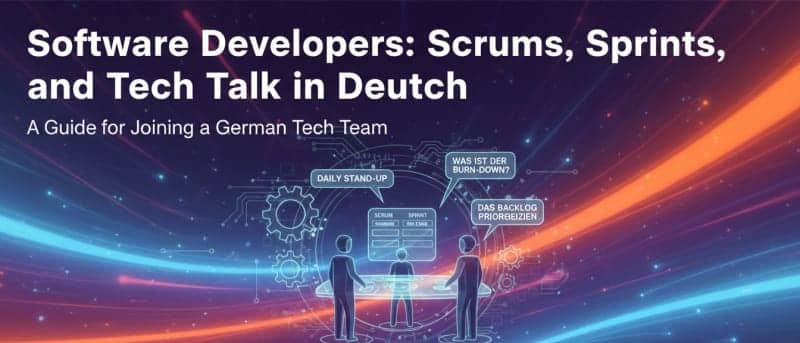
German for Software Developers: Scrums, Sprints, and Tech Talk in Deutsch
When I first started looking for jobs in Germany, I was searching for one thing more than anything else: how developers actually talk at work. I had the grammar and the certificates, but I had no idea what to say in a Daily Stand-up or how to ask for a Code Review in German. I spent hours looking for a guide that would give me the exact phrases and the Scrum vocabulary that real teams use—not textbook German, but the mix of English and German that I kept hearing in job descriptions and interview prep. The DACH region (Germany, Austria, and Switzerland) is one of the most robust software markets in the world—from the automotive hubs of Stuttgart and Munich to fintech in Frankfurt and the startup scene in Berlin—and the demand for skilled developers is high. What I learned the hard way: while English is the lingua franca of code, German is often the lingua franca of the office. In my first week I sat in a Planning meeting and understood maybe half of what was said; the other half was "Denglish" and Agile terms I had never learned. Mastering "Tech German" was not just vocabulary for me; it was cultural integration and actually being able to contribute without the friction of a language barrier. This guide is the resource I wish I had had from day one. I have focused on practical, real-world usage—the phrases and terms I hear and use in an Agile, German-speaking team.
1. Scrum and Agile Vocabulary in German
In the DACH region, Agile methodologies are standard. What I was not prepared for was the "Denglish" mix: most Scrum ceremonies keep their English names, but they are embedded in German sentence structures and take on German genders. I kept saying "der Sprint" wrong until a colleague corrected me. Below is the core vocabulary I use every week.
Core Scrum Ceremonies and Terms
| German term | English equivalent | Context / usage |
|---|
| Das Daily / Das Stand-up | Daily Stand-up | The 15-minute sync. |
| Der Sprint | Sprint | The fixed time-box for development. |
| Das Backlog | Product Backlog | The prioritized list of work. |
| Das Refinement | Backlog Grooming | Refining and estimating user stories. |
| Das Planning | Sprint Planning | Selecting tasks for the next sprint. |
| Die Review | Sprint Review | Presenting the work to stakeholders. |
| Die Retrospektive (Retro) | Retrospective | Looking back at the process. |
| Das Inkrement | Increment | The usable product piece. |
| Die Story / User Story | User Story | A requirement from the user's perspective. |
| Das Ticket / Der Task | Task / Ticket | A specific unit of work. |
| Die Schätzung | Estimation | Predicting effort (often in Story Points). |
How I Use These in the Agile Context
Der Sprint (plural: Sprints) is the set period in which we complete specific work. I use it in sentences like: "In diesem Sprint konzentrieren wir uns auf die Performance-Optimierung." (In this sprint we are focusing on performance optimization.)
Das Backlog is where we put future features and fixes. When something is not in scope for now, I say: "Wir müssen diese Aufgabe erst einmal ins Backlog schieben." (We need to push this task into the backlog for now.)
Die Definition of Done (DoD) is the criteria for a story to be considered complete. I often ask: "Entspricht das Ticket unserer Definition of Done?" (Does the ticket meet our Definition of Done?)
Die Kapazität is the team's available time or resources. When we are planning work I ask: "Haben wir noch Kapazität für ein weiteres Ticket?" (Do we have capacity for another ticket?)
2. Meeting and Communication Phrases
The Daily Stand-up was where my German was most visible. I was searching for a simple script, and most teams here follow the "Three Questions" format. Below is how I learned to navigate it.
Opening the Meeting
I use: "Fangen wir an?" (Shall we start?) or "Wer möchte anfangen?" (Who wants to start?) When it is my turn: "Ich mache mal weiter." (I'll go next.)
The "Three Questions" in German
1. What did I do yesterday? (Gestern) I say things like: "Gestern habe ich am Login-Feature gearbeitet." (Yesterday I worked on the login feature.) Or: "Ich habe den Bug im Frontend behoben." (I fixed the bug in the frontend.) Or: "Gestern habe ich die Dokumentation fertiggestellt." (Yesterday I finished the documentation.)
2. What will I do today? (Heute) For example: "Heute werde ich mich um das Refactoring kümmern." (Today I will take care of the refactoring.) Or: "Ich schließe heute den Task für die Datenbank-Migration ab." (I am closing the task for the database migration today.) Or: "Ich plane, heute den Pull Request zu erstellen." (I plan to create the pull request today.)
3. Are there any blockers? (Blocker / Hindernisse) When I am stuck I say: "Ich bin aktuell blockiert, weil mir die API-Zugangsdaten fehlen." (I am currently blocked because I lack the API credentials.) Or: "Es gibt ein Problem mit der Staging-Umgebung." (There is a problem with the staging environment.) Or: "Ich brauche Hilfe bei der Konfiguration." (I need help with the configuration.)
Status Updates I Use Every Day
"Noch in Arbeit" or "In Bearbeitung" means still in progress. I say: "Das Ticket ist noch in Arbeit." When my work is ready: "Bereit für Review" — "Meine Story ist bereit für Review." When something is done: "Abgeschlossen" or "Erledigt" — "Die Aufgabe ist erledigt." When we need to move something: "Verschieben" — "Können wir das auf den nächsten Sprint verschieben?" (Can we move this to the next sprint?)
3. Tech and Code Vocabulary
Variable names and syntax are in English, but the discussion about the code happens in German. I was constantly searching for the right nouns and verbs for technical deep-dives. Here is what I use now.
Essential Verbs for Developers
Programmieren / Entwickeln (to program / to develop), Implementieren (to implement), Testen (to test), Beheben / Fixen (to fix a bug), Hochladen / Pushen (to upload / to push code), Herunterladen / Pullen (to download / to pull code), Zusammenführen / Mergen (to merge), Ausrollen / Deployen (to deploy).
Technical Nouns I Use All the Time
| German term | English | Example |
|---|
| Die Fehlermeldung | Error message | "Was sagt die Fehlermeldung?" |
| Die Anforderung | Requirement | "Die Anforderungen sind unklar." |
| Die Schnittstelle | Interface / API | "Wir müssen die Schnittstelle anpassen." |
| Die Datenbank | Database | "Ist die Datenbank erreichbar?" |
| Die Umgebung | Environment | "In welcher Umgebung tritt der Fehler auf?" |
| Der Quellcode | Source code | "Ich schaue mir den Quellcode an." |
| Die Abhängigkeit | Dependency | "Wir haben zu viele Abhängigkeiten." |
| Das Repository (Repo) | Repository | "Klone bitte das Repo." |
Frontend vs. Backend Talk
In my team we say things like: "Das sieht im Frontend noch nicht richtig aus." (That does not look right in the frontend yet.) "Die API liefert einen 500er Fehler zurück." (The API is returning a 500 error.) "Wir müssen das State-Management optimieren." (We need to optimize the state management.) "Ist der Endpunkt schon dokumentiert?" (Is the endpoint already documented?)
4. Roles and Job Titles
German job titles often blend English with German suffixes. I was searching for "who is who" when I joined. Here is what I use now.
Der Softwareentwickler / Die Softwareentwicklerin (software developer), Der Fachinformatiker (common vocational title for IT specialists), Der Anwendungsentwickler (application developer), Der Teamleiter / Tech Lead (team lead / technical lead), Der Abteilungsleiter (head of department), Der Werkstudent (working student—very common in German tech), Der Quereinsteiger (career changer in IT), Der Ansprechpartner (point of contact). I often ask: "Wer ist mein Ansprechpartner für das Deployment?" (Who is my contact person for the deployment?)
5. Useful Sentences for the Office
Communication is not only technical terms; it is collaboration. I use these on Slack, Teams, and at the coffee machine.
Asking for Help
"Hast du kurz Zeit?" (Do you have a moment?) "Kannst du mal über meinen Code schauen?" (Can you take a look at my code?) "Ich komme hier nicht weiter. Hast du eine Idee?" (I am stuck here. Do you have an idea?) "Können wir uns das kurz gemeinsam ansehen?" (Can we look at this together briefly?)
In a Code Review (PR/MR)
"Das sieht gut aus!" (Looks good!) "Ich habe ein paar Anmerkungen im PR hinterlassen." (I left a few comments in the PR.) "Könntest du das bitte noch refactoren?" (Could you please refactor this?) "Guter Fang!" (Good catch!) "Bitte noch die Tests anpassen." (Please adjust the tests.)
Slack and Async
"Bin im Meeting." (In a meeting.) "Gleich wieder da." (Back soon / BRB.) "Bin im Feierabend." (Finished for the day / off work.) "Kannst du mir den Link schicken?" (Can you send me the link?) "Schau ich mir an." (I will take a look.)
6. Pronunciation and Linguistic Nuances
German is phonetic, which helped me, but some "Denglish" habits tripped me up at first.
Genders of Tech Terms
Most borrowed English tech terms take neuter (das) or masculine (der): Der Bug, Der Sprint, Der Branch, Der Server. Das Backlog, Das Tool, Das Deployment, Das Framework. Die API, Die Cloud, Die Library (often Die Bibliothek). I keep a short list on my desk.
Pronunciation Pitfalls I Had to Fix
Sprint: In German, "sp" at the start of a word is pronounced "shp". So "Sprint" sounds like Shprint. I said it wrong for weeks. Version: Pronounced Ver-zee-ohn, not the English ver-zhun. Architektur: The "ch" is a soft hissy sound (like in "ich"), not a "k".
What Worked for Me
I listened to German tech podcasts like "Engineering Kiosk" and "Heise Show" to hear how professionals talk about tech in real sentences. I also started writing my Daily notes in German first, even when we spoke English in the meeting—that alone forced me to learn "Gestern habe ich..." and "Heute werde ich..." by heart. I use Anki flashcards for the action verbs (mergen, committen, beheben) because I kept mixing them up in speech. Some developers switch their IDE or OS to German to learn terms like "Einstellungen" (Settings) or "Datei" (File); I kept mine in English but picked up the terms from colleagues and from our internal Wiki. One thing I was searching for and never found in a single place was a clear list of German genders for tech terms—so I built my own and shared it above. It saved me a lot of hesitation in meetings.
7. A Practical Dialogue: Developer and Product Owner
To tie everything together, here is a typical exchange I have had (and that you might have) between a developer and a Product Owner. I have used this style of conversation many times.
Lars (Developer): "Guten Morgen, Sarah. Ich habe eine Frage zum Backlog-Item #402."
Sarah (Product Owner): "Morgen, Lars. Geht es um die Anforderungen für den Checkout?"
Lars: "Genau. Die User Story beschreibt, dass wir PayPal integrieren sollen. Aber ist die Schnittstelle schon bereit?"
Sarah: "Gute Frage. Laut dem Tech Lead ist das Backend fertig, aber die Dokumentation fehlt noch."
Lars: "Okay. Dann schiebe ich das Ticket wieder auf 'In Bearbeitung' und warte auf die API-Specs. Ich möchte keinen Bug produzieren, weil die Datenfelder unklar sind."
Sarah: "Alles klar. Setz es einfach als Blocker ins Daily, damit alle Bescheid wissen."
Conclusion
From my experience, navigating the German tech landscape is a blend of technical precision and linguistic flexibility. I was searching for a way to sound competent and collaborative without having to speak perfect German—and that meant nailing the nouns and verbs that come up every day: Sprint, Backlog, Ticket, Blocker, Review, Refactoring. By getting comfortable with the core Scrum terms, understanding the flow of a Sprint, and using the practical Tech Talk in this guide, I started to feel like a real part of the team instead of the person who stayed quiet in Retros. German teams value clarity and directness; they would rather you say "Ich bin blockiert" clearly than struggle through a long, grammatically perfect sentence. I stopped worrying about perfect grammar in the heat of a deployment and focused on the key phrases that convey status and needs. My advice: choose three phrases from the Daily Stand-up section and try them in your next meeting. Even if you speak 90% English, starting with "Gestern habe ich..." and ending with "Keine Blocker" shows effort and builds rapport. For more on German for work and exams, check out our learning resources.
Vocabulary and usage can vary by company and region. Large enterprises may use more formal German; startups may rely almost entirely on English. When in doubt, I look at our team's Slack channels or Wiki to see which terms we use.
Official sources & references
Authoritative links for Agile/Scrum, the German IT job market, and the roles and terms used in this guide.