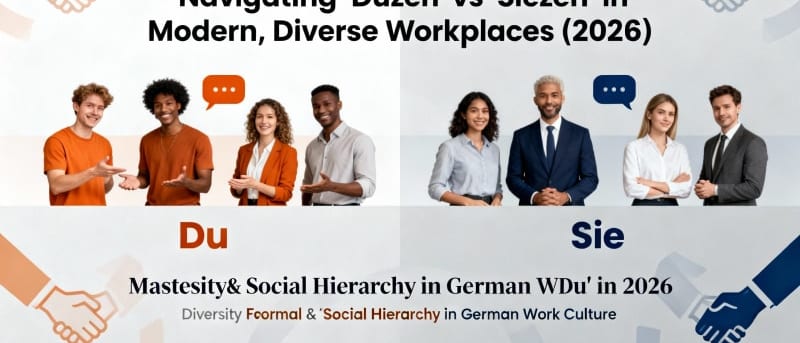
Duzen vs. Siezen at Work: 2026 German Office Guide
Navigating the German workplace has always required a keen sense of social hierarchy, primarily expressed through two words for "you": the formal Sie and the informal Du. As we move through 2026, the lines are blurring, but the stakes remain high. Using the wrong form can still range from a minor awkwardness to a major professional faux pas.
In 2025 and 2026, German social etiquette continues its shift toward informality, driven by digital transformation and generational changes, yet core formal structures remain. While Duzen (informal "you") is becoming the norm in agile, international, and tech-driven environments, the formal Siezen still serves as the baseline for respect and professional distance in many sectors.
This comprehensive guide explores the historical and cultural context of Duzen and Siezen, traditional rules, modern workplace evolution, industry variations, regional differences, international workplace navigation, making the switch, common mistakes, email etiquette, video calls and remote work, and essential resources for mastering German workplace formality in 2026.
1. Introduction: The Complexity of German Formality
German workplace formality is one of the most nuanced aspects of professional culture in Germany. Unlike English, which has only one word for "you," German has two distinct forms that carry significant social meaning:
- Sie (formal): Conveys respect, professional distance, and hierarchy
- Du (informal): Implies closeness, familiarity, and equality
The choice between these forms is not arbitrary—it reflects power dynamics, social relationships, and cultural expectations. In 2026, this system is evolving, but understanding the rules remains essential for professional success in Germany.
Why It Matters
Using the wrong form can:
- Create social friction or perceived disrespect
- Signal that you don't understand German workplace culture
- Impact your professional relationships and career advancement
- Lead to awkward situations or even professional conflicts
Mastering Duzen and Siezen is not just about language—it's about understanding German professional culture and building successful working relationships.
2. Understanding Duzen and Siezen: Historical and Cultural Context
Siezen (Formal)
Using Sie conveys professional distance, respect, and neutrality. It is the default for strangers and superiors.
Characteristics:
- Uses third-person plural verb forms (Sie sind, Sie haben, Sie können)
- Capitalized in writing to distinguish from "sie" (they)
- Accompanied by titles and surnames (Herr/Frau + Surname)
- Signals respect and professional boundaries
When Sie is Required:
- Addressing strangers or new acquaintances
- Speaking with superiors or higher-ranking colleagues
- Client interactions in traditional sectors
- Formal written communication
- Interactions with government officials, police, or legal professionals
Duzen (Informal)
Using Du implies closeness, familiarity, or membership in a specific "in-group" (like a startup team).
Characteristics:
- Uses second-person singular verb forms (du bist, du hast, du kannst)
- Accompanied by first names
- Signals equality, friendship, or team membership
- Creates a sense of informality and approachability
When Du is Appropriate:
- Among friends and family
- Within startup teams and creative agencies
- After explicit "Du-Angebot" (offer to use Du)
- In informal social settings
- Among peers in casual work environments
3. Traditional Rules: The "Sie" Foundation
Historically, the rule was simple: you use Sie with everyone until the higher-ranking person (or the older person) explicitly offers the Du. This is known as the "Du-Angebot" (offer to use Du).
The Traditional Hierarchy Rule
In Business Settings:
- The higher-ranking person always offers the Du first
- Rank takes precedence over age
- Gender does not affect who offers the Du
- Refusing a Du-Angebot is considered impolite unless you have a specific reason
In Private Settings:
- The older person typically offers the Du
- Age takes precedence over other factors
- More flexible than business settings
Traditional Sectors (2026)
In traditional sectors like banking, law, or the public sector (Öffentlicher Dienst), the Sie foundation remains the gold standard in 2026:
- Banking: Sie is standard, even among long-term colleagues
- Law: Formal address is maintained to preserve professional distance
- Public Sector: Hierarchical structures require formal address
- Insurance: Conservative approach maintains Sie as default
- Manufacturing (Mittelstand): Traditional family businesses often maintain formal structures
Service and Status: A general rule in 2025-2026 is that the more expensive the product or the higher the official status (e.g., doctors, lawyers, police), the more likely Sie is required.
4. Modern Workplace Evolution: The Rise of "Du"
The "Startup Culture" of the 2010s has become the "New Work" reality of 2026. Many German companies, including giants like SAP and Adidas, have adopted a corporate-wide Du.
The "Du" Wave
Accelerated by international corporate cultures and digital tools like Slack, Du is increasingly used from the start in tech, creative, and e-commerce industries.
- Tech & Creative: Immediate Du from the interview onwards
- E-commerce: Informal culture from day one
- Media & Marketing: Creative agencies default to Du
- Startups: Du is expected, Sie might make you seem like an outsider
Hierarchical "Du"
In "New Work" models, CEOs of major firms (e.g., SAP, Adidas) have transitioned to corporate-wide Du to flatten hierarchies.
The Goal: To flatten hierarchies and encourage open communication.
The Risk: Just because everyone says Du doesn't mean the hierarchy has disappeared. Professional boundaries still exist.
Generational Demands
Gen Z entering the workforce in 2026 views flexibility and authentic, informal communication as essential, often pushing for immediate Duzen. This generational shift is reshaping workplace culture across industries.
5. Industry Variations: Tech Startups vs. Traditional Corporations
Industry context significantly influences formality expectations:
| Industry |
Default Form |
Notes |
| Tech & Creative |
Du (immediate) |
Startups, media, IT companies expect Du from interview onwards |
| Traditional (Banking, Law, Insurance) |
Sie (default) |
Start with Sie, wait for manager to suggest otherwise |
| Manufacturing (Mittelstand) |
Sie (traditional) |
Conservative approach, formal structures maintained |
| Retail & Hospitality |
Mixed |
Sie with customers, Du among colleagues |
| Healthcare |
Sie (patients), Du (colleagues) |
Formal with patients, informal among medical staff |
| Education |
Sie (students to teachers), Du (colleagues) |
Formal student-teacher relationship, informal among staff |
6. Regional Differences: North vs. South, East vs. West
Regional culture significantly influences workplace formality:
Berlin/Hamburg (The North)
Highly informal; "Duzen" is often expected from day one in digital sectors.
- Startup capital of Europe
- Large international community
- Tech and creative industries dominate
- Du is the default in most modern workplaces
- More relaxed, international atmosphere
Munich/Stuttgart (The South)
More conservative; expect "Siezen" in automotive and manufacturing sectors until a personal rapport is built.
- Traditional industries (automotive, manufacturing)
- More hierarchical corporate structures
- Sie remains standard in established companies
- Bavarian culture emphasizes respect and formality
- Du comes after building relationships
Frankfurt (Financial Center)
- Banking and finance sector maintains strict formality
- Sie is standard in traditional financial institutions
- International banks may be more flexible
Eastern Germany (Leipzig, Dresden)
- Growing tech scenes with more informal cultures
- Lower cost of living attracts startups
- Mix of traditional and modern approaches
7. International Workplaces: Navigating in Diverse Teams
In 2026, many German offices operate in English. While English only has one "you," the mindset of Siezen often carries over.
The "Hamburger Sie"
Using the first name with Sie (e.g., "Michael, haben Sie die Unterlagen?"). This is a common middle ground in international firms.
Characteristics:
- First name + formal Sie verb form
- Balances friendliness with professional hierarchy
- Common in modern corporate settings
- Example: "Hallo Thomas, könnten Sie mir bitte helfen?"
The "Münchner Du"
Using the surname with Du (e.g., "Müller, hast du kurz Zeit?"). Rare, but still found in some traditional trades.
Characteristics:
- Surname + informal Du verb form
- Maintains some distance while using informal address
- Found in traditional crafts and trades
- Less common in modern workplaces
English-Dominant Workplaces
Even in English-speaking offices, the underlying cultural "social distance" remains. Many German teams use "you" in English but switch to the formal Sie when speaking German until a closer rapport is established.
8. Making the Switch: How to Transition from Sie to Du
Never switch to Du unilaterally. The transition from Sie to Du should only be initiated by the higher-ranking or older person.
The "Du-Angebot" (Offer to Use Du)
Who Offers:
- Higher-ranking person in business settings
- Older person in private settings
- Person with longer tenure in the organization
How It's Offered:
- "Wir können uns gerne duzen" (We can use Du)
- "Lass uns duzen" (Let's use Du)
- "Darf ich Sie duzen?" (May I use Du with you?)
Accepting:
- "Gerne, ich bin [Name]" (Gladly, I'm [Name])
- "Ja, gerne" (Yes, gladly)
- Simply switch to Du in your response
Refusing: It is considered impolite to refuse a Du-Angebot unless you have a very specific reason to maintain distance.
The "Corona-Legacy"
Since the pandemic, many switches happen via email or Slack rather than over a formal drink. Digital communication has made the transition more casual and less ceremonious.
Consistency is Key
Once Du is established, reverting to Sie is often interpreted as a severe personal insult or a sign of an irreparable professional rift. Consistency is essential—once you've agreed to use Du, it's expected to continue.
9. Common Mistakes: What to Avoid
The "False Familiarity"
Mistake: Using Du with a client just because your internal office uses it.
Solution: Always use Sie with external clients unless they explicitly offer Du. Internal informality does not extend to client relationships.
Mixing Forms
Mistake: Switching between Du and Sie in the same conversation.
Solution: Choose one form and stick with it. Consistency is crucial for maintaining professional relationships.
Forgetting the "Du"
Mistake: If you've been offered the Du and you go back to Sie, it can signal that you are angry or distancing yourself.
Solution: Once Du is established, maintain it. Reverting to Sie is a serious social signal that should be avoided unless intentional.
Uninvited Duzen
Mistake: Using Du without being offered it, especially with superiors or in traditional sectors.
Solution: Always start with Sie unless you're in a startup or creative agency where Du is the default. "When in doubt, Sie" is the safest approach.
Assuming English = Informal
Mistake: Assuming that because a workplace uses English, formality doesn't matter.
Solution: Even in English-speaking offices, German cultural norms about hierarchy and respect often carry over. Observe how German colleagues interact.
10. Email Etiquette: Formal vs. Informal Communication
Email communication requires careful attention to formality levels:
Formal Email
Salutation: Sehr geehrte Frau Müller / Sehr geehrter Herr Schmidt
Body: Use Sie throughout, formal language
Closing: Mit freundlichen Grüßen
Signature: Full name, title, company
When to Use: Initial contact, client communication, traditional sectors, formal requests
Semi-Formal Email
Salutation: Guten Tag Herr Schmidt / Liebe Frau Müller
Body: Use Sie, but slightly more relaxed tone
Closing: Beste Grüße / Viele Grüße
Signature: First name + last name, or first name only if relationship is established
When to Use: Ongoing professional relationships, internal communication in traditional companies
Informal Email
Salutation: Hallo Christian / Hi Maria
Body: Use Du, casual language
Closing: Viele Grüße / Liebe Grüße
Signature: First name only
When to Use: After Du-Angebot, startup/tech environments, close colleagues
Reading Email Signatures
Formal Signal: "Mit freundlichen Grüßen, Dr. Schmidt" → Stick to Sie
Informal Signal: "Beste Grüße, Thomas" → Du is likely coming soon
Watch the Signature: Email signatures often indicate the expected level of formality.
11. Video Calls & Remote Work: Etiquette in Digital Spaces
As hybrid models become standard in 2026, digital communication etiquette has evolved:
Remote Work Boundaries
The "right to disconnect" is strictly observed. Sending informal messages outside of core hours is often seen as a breach of work-life balance.
- Core Hours: Respect standard working hours (typically 9 AM–6 PM)
- Urgent Matters: Use formal channels for urgent after-hours communication
- Weekend Communication: Generally avoided unless critical
Virtual Meetings
In remote settings, it is common to start with Sie unless the group's "Slack culture" has already established Du.
- Initial Meetings: Default to Sie until relationship is established
- Team Meetings: Follow the team's established culture
- Client Meetings: Always use Sie unless client offers Du
- Observe Channel Culture: Slack/Teams generally defaults to Du in 2026, but observe the channel culture first
Digital Communication Platforms
Slack/Teams: Generally defaults to Du in 2026, but observe the channel culture first. Internal channels are often more informal than email.
LinkedIn: In 2026, LinkedIn in Germany has become significantly more informal. Du is common in comments, but use Sie for initial cold outreach to senior recruiters.
WhatsApp (Work Groups): Often uses Du, but depends on company culture. More informal than email or Slack.
12. FAQs Section: Etiquette Questions
Q1: What if I'm unsure which form to use?
A: Always default to Sie. It is much easier to move from Sie to Du than to apologize for being accidentally disrespectful. "When in doubt, Sie" is the safest approach. You can never offend someone by being too polite, but you can by being too familiar.
Q2: Can I use "Du" on LinkedIn?
A: In 2026, LinkedIn in Germany has become significantly more informal. Du is common in comments and discussions, but use Sie for initial cold outreach to senior recruiters or professionals you don't know. Once a relationship is established, Du may be appropriate.
Q3: Who is supposed to offer the "Du" first?
A: In the business world, the higher-ranking person is always the one to suggest switching to the informal du, regardless of age or gender. In purely private settings, the older person typically makes the offer. The hierarchy rule means you should wait for your superior or the person with longer tenure to offer the Du first.
Q4: Can I use "Du" with my boss if they use it with me?
A: Only if it has been explicitly offered. If a superior addresses you with du, it is generally an invitation to reciprocate, but it is safest to wait for a clear signal or ask: "Wollen wir uns duzen?" (Shall we use Du?). When a colleague says "Wir können uns gerne duzen" (We can use Du), it is a social green light you should almost always accept.
Q5: Is "Sie" still the norm in 2026?
A: In traditional sectors like banking, law, or the Mittelstand (SMEs), Sie remains the standard for maintaining professional distance and respect. However, in agile and international environments, "Duzen" is increasingly taken for granted. "Duzen" is now the default in over 60% of tech and creative hubs. The key is reading your specific workplace culture.
Q6: What is the "Hamburger Sie"?
A: This is a common intermediate step where you address someone by their first name but still use the formal Sie. It is often used in modern corporate settings to balance friendliness with professional hierarchy. For example, "Hallo Thomas, könnten Sie mir bitte helfen?" combines the first name with the formal Sie verb form.
Q7: Can I switch back to "Sie" after agreeing to "Du"?
A: No. Reverting to Sie after a "Du" agreement is established is often perceived as a significant social "slap in the face" or a sign that the relationship has severely soured. Once you've agreed to use Du, it's expected to continue. Switching back would be seen as a serious social rejection.
Q8: How should I address someone in an initial email?
A: Always use the formal Sie and their last name (e.g., "Sehr geehrte Frau [Surname]" or "Sehr geehrter Herr [Surname]") until invited to do otherwise. If they have a title like "Dr." or "Professor," it should be included. Watch the signature: If an email is signed "Mit freundlichen Grüßen, Dr. Schmidt," stick to Sie. If it's "Beste Grüße, Thomas," Du is likely coming soon.
Q9: What are the regional differences in workplace formality?
A: Berlin/Hamburg (The North): Highly informal; "Duzen" is often expected from day one in digital sectors. Munich/Stuttgart (The South): More conservative; expect "Siezen" in automotive and manufacturing sectors until a personal rapport is built. Startups vs. Corporate: In a startup, Sie might make you seem like an outsider. In a traditional bank, Du might make you seem unprofessional.
Q10: Is it rude to use Du in a German interview?
A: In traditional sectors, yes—always use Sie in interviews. However, in tech startups and creative agencies, Du may be expected from the interview onwards. Observe how the interviewer addresses you and match their level of formality. When in doubt, use Sie—it's better to be slightly too formal than too informal in an interview setting.
13. Resources: Guides, Examples, and Practice Scenarios
Official Resources
Professional Development
- StepStone Salary & Culture Planner: Insights into specific company cultures in Germany, helping you understand formality expectations by company.
- Industry Associations: Join professional associations in your field to observe how members address each other.
Language Learning
- Business German Courses: Many language schools offer specialized courses in professional German communication
- Cultural Training: Intercultural competence training programs for expats
- Practice Scenarios: Role-play exercises for workplace situations
Online Communities
- Toytown Germany: English-speaking forum for expats with extensive discussions on workplace culture
- Reddit r/germany: Active community for questions about German workplace etiquette
- LinkedIn Groups: Professional groups for expats in Germany
Conclusion: Mastering German Workplace Formality in 2026
Navigating Duzen and Siezen in modern German workplaces requires understanding both traditional rules and contemporary evolution. Key principles for 2026:
- Default to Sie: Always start with Sie unless you're in a startup or creative agency where Du is the default
- Observe Your Environment: Pay attention to how colleagues address each other
- Wait for the Offer: Never switch to Du unilaterally—wait for the higher-ranking person to offer it
- Be Consistent: Once Du is established, maintain it—switching back to Sie is a serious social signal
- Understand Context: Industry, region, and company culture all influence formality expectations
- Respect Boundaries: Even in informal environments, professional boundaries still exist
Key takeaways:
- Sie remains the safe default in traditional sectors (banking, law, Mittelstand)
- Du is now default in 60% of tech/creative hubs
- Regional variations: Berlin/Hamburg highly informal, Munich/Stuttgart more conservative
- The "Hamburger Sie" (first name + Sie) is a common middle ground in international firms
- Digital communication (Slack, Teams) generally defaults to Du in 2026
- Consistency is crucial—once Du is established, maintain it
- "When in doubt, Sie" is always the safest approach
Mastering German workplace formality is an ongoing process that requires observation, cultural sensitivity, and adaptability. By understanding both traditional rules and modern evolution, you can navigate German professional culture with confidence and build successful working relationships.
For more resources on working in Germany, see our guides on German Workplace Etiquette 2026, 2026 German Job Market, and Digital Nomad Guide to Germany.
Official sources & references
Authoritative links for German workplace culture, business language, and working in Germany cited in this guide. All links verified.