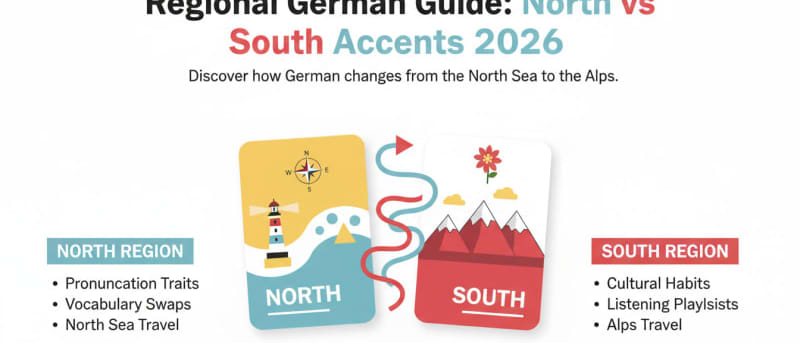
North vs. South German: The 2026 Guide to Regional Dialects
Germany stretches from windy coasts to mountain villages. Along that journey, German morphs—words change, vowels shift, and cultures add their flavour. This guide helps you understand (and enjoy) the differences between Northern and Southern German. Whether you are visiting Hamburg or Munich, studying for exams, or living in Germany, you will know what to expect and how to adapt.
What you will learn:
- Key pronunciation traits and speech melody in northern vs southern accents.
- Vocabulary swap lists so you recognise what locals mean.
- Cultural habits that shape communication styles.
- Listening playlists, podcasts, and YouTube channels for each region.
- Roleplays and dialogues to practise real-life conversations.
- A 14-day immersion plan for trips or focused study.
Table of Contents
- 1. Germany's North & South at a Glance
- 2. Accent & Pronunciation Features
- 3. Vocabulary & Expressions
- 4. Grammar & Syntax Nuances
- 5. Cultural Habits & Communication Styles
- 6. Food, Festivals, and Everyday Life
- 7. Listening & Reading Resources
- 8. Travel Survival Tips
- 9. Roleplays & Practice Dialogues
- 10. 14-Day North/South Immersion Plan
- 11. Downloadables & Checklists
- 12. Frequently Asked Questions
1. Germany's North & South at a Glance
Northern Germany (Hamburg, Bremen, Hannover, Berlin, coastal cities) is home to low German roots and the birthplace of Standard German pronunciation. Speech tends to be flatter in melody with clear consonants. Culture leans maritime, international, and direct.
Southern Germany (Bavaria, Baden-Württemberg, Swabia, Alpine towns) draws on Alemannic and Bavarian dialect families. Speech is melodic and vowel-rich, with rolled r's in many areas. Culture emphasises traditions, community gatherings, and regional pride.
2. Accent & Pronunciation Features
Northern Accent Traits
- Clear ich-Laut [ç]: “Ich” pronounced [ɪç].
- Flat intonation: Sentences stay relatively level.
- Short vowels: Words like “mit” and “bitte” are crisp.
- Berliner variation: g → j (gut → jut), dropping final -e (“hab” instead of “habe”).
Southern Accent Traits
- ei → oa shift: Weiß → Woas in Bavarian areas.
- Rolled r's: In rural Bavaria/Austria you hear a trill.
- Soft consonants: k → g, t → d in some dialects (“Tag” → “Dog”).
- Melodic intonation: Sentences rise and fall clearly.
Practice: Shadow short clips from Hamburg and Munich. Focus on vowel length and r sounds.
3. Vocabulary & Expressions
Learn these common swaps to avoid surprises:
| Standard German |
North German |
South German |
Meaning |
| Brötchen |
Schrippe |
Semmel / Weck |
Bread roll |
| Bouletten |
Bulette / Frikadelle |
Fleischpflanzerl |
Meatball/patty |
| Kartoffel |
Erdäpfel (rare) |
Erdapfel (Austrian influence) |
Potato |
| Hallo |
Moin! (all day) |
Servus! / Grüß Gott! |
Hello/Good day |
| Freundlich |
Freundlich / nett |
lieb / g'miatlich |
Friendly |
| Sache erledigt |
Alles klar. |
Passt scho. |
It's all good. |
Listen for filler words too: North Germans use “na ja”, “halt” sparingly; southern speakers sprinkle “fei” (Upper Bavaria) or “gell” (Swabia/Austria) for emphasis.
4. Grammar & Syntax Nuances
Grammar is the same nationwide, but you will hear these differences:
- Dative for possession in the south: “dem Peter sein Auto” instead of Genitive.
- Dropping articles in the north: “Ich geh zur Arbeit” vs “I geh zur Arbeit” (south may shorten verbs differently).
- Regional verb forms: “Ich bin” vs southern “I bin” (pronounced short), or “I geh” vs “Ich gehe.”
For exams and formal writing always use standard grammar. For listening, recognise these variations as shortcuts, not errors.
5. Cultural Habits & Communication Styles
North
- Direct communication: Clear yes/no, fewer filler compliments.
- Punctuality & structure: Meetings start on time, fluid small talk but not too personal.
- Sea influence: Maritime festivals, fish dishes, strong trading history.
South
- Warm greetings: Handshakes, direct eye contact, “Servus” even among strangers.
- Traditions: Dirndl & Lederhosen at events, local dialect pride.
- Hospitality: Family-style meals, community festivals (Oktoberfest, Frühlingsfest).
Adjust accordingly: in Munich a “Servus” earns smiles; in Hamburg “Moin” works all day.
6. Food, Festivals, and Everyday Life
Northern favourites: Fischbrötchen, Labskaus, Grünkohl mit Pinkel (winter dish), Franzbrötchen pastries in Hamburg.
Southern favourites: Weißwurst breakfast with Brezn, Käsespätzle, Schweinshaxe, Kaiserschmarrn dessert.
Festivals: Hamburg Port Anniversary, Kiel Week sailing festival vs. Munich Oktoberfest, Stuttgart Cannstatter Volksfest, Nuremberg Christkindlesmarkt.
7. Listening & Reading Resources
Northern Germany
- Podcast: “Hamburg News” (evening updates).
- YouTube: “Hamburg 1 Nachrichten”, “Strandkorb Stories”.
- Books: “Der nasse Fisch” (Volker Kutscher) for Berlin 1920s vibe.
- Music: Revolverheld, Deichkind, Seeed (Berlin-based).
Southern Germany
- Podcast: BR Heimat “Habe die Ehre”.
- YouTube: “Servus TV”, “Bayern erleben”.
- Books: “Die Känguru-Chroniken in Mundart” (regional editions), “Oberammergau Krimis”.
- Music: LaBrassBanda, Moop Mama, Haindling.
8. Travel Survival Tips
North:
- Weather can be windy and wet—pack layers.
- Public transport announcements are in Standard German; dialect appears in casual chats.
- Try local specialties at weekly markets (Wochenmarkt).
South:
- Expect informal small talk in shops and beer gardens.
- Be ready for dialect signage (e.g., “Griaß di” greetings).
- Cash still preferred in small Alpine towns.
9. Roleplays & Practice Dialogues
Ordering a Coffee in Hamburg
Barista: “Moin! Was darf es sein?”
Kundin: “Ein Flat White, bitte. Und haben Sie Franzbrötchen?”
Barista: “Aber klar. Möchten Sie es hier oder to go?”
Kundin: “Hier, danke.”
Ordering in Munich
Bedienung: “Servus! Was derf's sei?”
Gast: “A Cappuccino bitte und a Brezn.”
Bedienung: “Kommt sofort. Setzt di ruhig, gell.”
Gast: “Merci! Passt scho.”
Practice each with the appropriate accent and fillers. Record yourself and compare to native clips.
10. 14-Day North/South Immersion Plan
Alternate focus each day to build a balanced ear.
- Day 1: Watch a Hamburg travel vlog. Shadow key sentences.
- Day 2: Listen to BR Heimat radio while following transcript.
- Day 3: Memorise 10 north-specific vocabulary items. Use them in sentences.
- Day 4: Memorise 10 south-specific expressions. Practise with roleplays.
- Day 5: Compare two news articles (northern vs southern outlets). Highlight dialect differences.
- Day 6: Cook a regional recipe (Labskaus or Weißwurst breakfast) while watching a German cooking video.
- Day 7: Rest/listen passively to a playlist of North German artists.
- Day 8: Interview a language partner about their region (prepare questions).
- Day 9: Practice two-way prepositions with travel sentences (“Ich fahre auf den/auf dem Deich”).
- Day 10: Study cultural etiquette—read guides on greetings, tipping, punctuality.
- Day 11: Watch a Bavarian comedy sketch; note pronunciation you find challenging.
- Day 12: Visit a German bakery/grocery (local or online order). Practise vocabulary in context.
- Day 13: Record yourself summarising the differences you learned.
- Day 14: Plan next month's focus: maybe Austrian vs Swiss or city-specific deep dive.
11. Downloadables & Checklists
- Vocabulary swap sheet (north vs south).
- Pronunciation cheat sheet by region.
- Cultural etiquette checklist.
- 14-day immersion planner (fillable PDF).
- Listening resource list with QR codes/links.
12. Frequently Asked Questions
Do I need to speak like locals?
No. Understand them first; adapt your speech only if you live there long-term. Clear Standard German is always appreciated.
How different are northern and southern dialects?
Standard German is mutually intelligible everywhere. Differences increase in rural areas or when locals speak among themselves, but context and experience help you follow along.
What if I don't understand a word?
Politely ask: “Was bedeutet das (auf Hochdeutsch)?” Most people will explain with a smile.
Should I focus on one region when learning?
Start with Standard German, then explore the region you live in or visit often. Exposure to both north and south builds excellent listening skills.
Conclusion: Enjoy Germany's Regional Diversity
Germany's north and south offer distinct flavours of language and culture. Rather than feeling overwhelmed, treat these differences as a linguistic adventure. With the vocabulary swaps, accent tips, and practice plan in this guide, you can travel, study, or work in any region with confidence.
Next step: Pick today's activity from the 14-day plan, listen to a regional clip, and note two new expressions. Repeat tomorrow with the other region. Soon, you'll be comfortable from the North Sea to the Alps.
Official sources & references
Authoritative language and regional media sources for standard and regional German. All links verified.