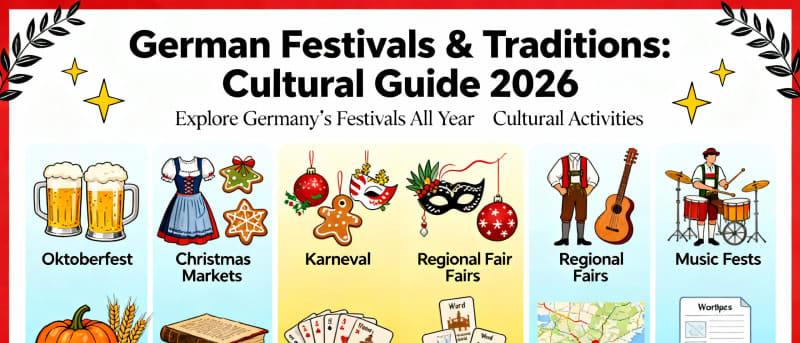
German Festivals and Traditions: Celebrate the Culture All Year
From winter markets glowing with Glühwein to summer street parades with brass bands, Germany celebrates community every month. This guide takes you through the most important festivals, traditions, vocabulary, and insider tips so you can experience them like a local—whether you are visiting, studying abroad, or learning German from home.
What you will find:
- Month-by-month festival calendar with regional highlights.
- Background stories, cultural etiquette, and must-know phrases.
- Food and drink vocabulary, costume tips, and local customs.
- Travel planning advice for tickets, transportation, and accommodation.
- Language practice ideas: dialogues, journaling prompts, and listening recommendations.
Table of Contents
- 1. How to Use This Festival Guide
- 2. Month-by-Month Festival Calendar
- 3. Spotlight: Major National Celebrations
- 4. Regional Traditions You Shouldn’t Miss
- 5. Essential Vocabulary & Expressions
- 6. Food, Drinks, and Customs
- 7. Planning Tips (Tickets, Transport, Budget)
- 8. Cultural Etiquette & Sustainability
- 9. Language Practice Activities
- 10. 12-Month Festival Challenge
- 11. Downloadables & Resource Links
- 12. FAQs & Next Steps
1. How to Use This Festival Guide
Select the month you plan to travel or study, learn the background of the festival, note traditional phrases, and set practical goals. Combine cultural exploration with German practice: watch live streams, fill in vocabulary sheets, or roleplay ordering local specialties.
2. Month-by-Month Festival Calendar
January
- Neujahr (New Year): Fireworks at midnight, “Frohes neues Jahr!” greetings, and Bleigießen fortune telling.
- Dreikönigstag (Epiphany, 6 January): Star singers (Sternsinger) visit homes in many regions, especially Bavaria and Baden-Württemberg.
- Winter Jazz Festivals: Stuttgart’s “Jazz Open” teaser events warm up the season.
February
- Karneval / Fasching / Fastnacht: Costume parades, street parties, Rosenmontag floats in Cologne, Mainz, Düsseldorf. Traditional greetings: “Helau!” (Mainz, Düsseldorf), “Alaaf!” (Cologne).
- Berlinale Film Festival: International film premieres in Berlin mid-February; red carpet vocabulary and cinema culture.
March
- Starkbierzeit (Strong Beer Season) in Munich: Celebrated at Paulaner am Nockherberg with satirical “Derblecken” speeches.
- Frühlingsfeste (Spring Fairs): Smaller funfairs start in cities like Leipzig and Hamburg.
April
- Osterbräuche (Easter traditions): Easter fires (Osterfeuer), egg decorating (Eier bemalen), Easter markets.
- Walpurgisnacht (30 April): Bonfires and witch-themed festivities in the Harz Mountains.
May
- Maifeiertag (1 May): Maypole (Maibaum) raising, dance into May (“Tanz in den Mai”), workers’ demonstrations.
- Rhein in Flammen: Fireworks along the Rhine, boat parades, wine tastings.
- Kirchentag (Church Convention): Alternating Protestant and Catholic congresses with concerts and workshops.
June
- Christopher Street Day (CSD): LGBTQ+ pride parades in Berlin, Cologne, Munich.
- Schützenfeste: Traditional marksmen festivals with parades, shooting competitions, brass bands.
- Kieler Woche: Sailing regatta plus international music festival in Kiel.
July
- Rothenburger Meistertrunk: Historical reenactment of a mayor saving the town during the Thirty Years’ War.
- Open-Air Music Festivals: Rock am Ring, Fusion, Melt!, Wacken (metal). Learn concert vocabulary and camping tips.
- Weinfeste (Wine festivals): Start in Rhineland-Palatinate—tasting booths and vineyard tours.
August
- Classical Festivals: Bayreuth Festival (Wagner operas), Salzburg Festival (Austrian but popular with Germans).
- Street Food Markets: Berlin’s “Stadt Land Food”, Nuremberg’s “Street Food Festival”.
- Volksfeste: Hanover Schützenfest, Cranger Kirmes funfair in Herne.
September
- Oktoberfest (late September–early October): Munich’s iconic beer festival with dirndl/lederhosen, brass bands, folk dances.
- Neue Wein Saison: Federweißer tastings, onion tart (Zwiebelkuchen) season.
- Reeperbahn Festival in Hamburg: Europe’s largest club festival with panels and concerts.
October
- Tag der Deutschen Einheit (3 October): Unity Day celebrations rotate between federal states with concerts and open-air events.
- Frankfurter Buchmesse: International book fair with author talks, language industry networking.
- Herbstmärkte: Harvest fairs featuring pumpkins, herbs, regional crafts.
November
- St. Martin’s Day (11 November): Lantern processions (Laternenumzüge), goose dinners (Martinsgans), children’s songs.
- Karnevalsauftakt (11 November, 11:11 AM): Official start of new carnival season.
- Jazzfest Berlin: Contemporary jazz performances, radio broadcasts for listening practice.
December
- Weihnachtsmärkte: Nuremberg Christkindlesmarkt, Dresden Striezelmarkt, Berlin Gendarmenmarkt.
- Advent traditions: Adventskranz (wreath), Adventskalender (calendar), Nikolaustag (6 December).
- Silvester (New Year’s Eve): Raclette fondue, “Dinner for One” TV classic, fireworks.
3. Spotlight: Major National Celebrations
Oktoberfest
Held in Munich, late September to early October. Key vocabulary: Maß (liter of beer), Wiesn (local nickname), Festzelt (beer tent), Brezn (pretzel). Etiquette: reserve tables in advance, stand on benches only when the band invites, tip servers (Trinkgeld). Dress: dirndl, lederhosen, checkered shirts, Haferlschuhe.
Karneval (Cologne, Mainz, Düsseldorf)
Events include Weiberfastnacht (women cut men’s ties), Rosenmontag parade, Veilchendienstag. Costumes encouraged, confetti everywhere. Useful phrases: “Kölle Alaaf!”, “Bützje?” (kiss on the cheek). Music: Karnevalsschlager songs.
Weihnachtsmärkte
Christmas markets open from late November. Traditional foods: Bratwurst, Gebrannte Mandeln (candied almonds), Stollen, Glühwein. Vocabulary: Weihnachtsschmuck (ornaments), Handwerk (craft), Lichterkette (string lights).
Volksfeste
City fairs such as Cannstatter Volksfest (Stuttgart), Hamburger Dom, and Gäubodenvolksfest (Straubing). Expect roller coasters, beer tents, parade floats, and regional specialties.
4. Regional Traditions You Shouldn’t Miss
- Hamburg: Hafengeburtstag (Port Anniversary), “Alstervergnügen” street festival.
- Berlin: Karneval der Kulturen (multicultural parade), Fête de la Musique (free concerts).
- Bavaria: Almabtrieb (cattle drive) in the Alps, Leonhardifahrt horse pilgrimage.
- Rhineland-Palatinate: Weinfests with Federweißer and Riesling competitions.
- Thuringia & Saxony: Christmas pyramids, nutcracker carving, Krämerbrückenfest in Erfurt.
- Black Forest: Fasnet (Swabian-Alemannic carnival) with wooden masks and Swabian dialect.
5. Essential Vocabulary & Expressions
| German |
English |
Usage |
| Festzelt |
Festival tent |
“Lass uns ins Festzelt gehen.” |
| Eintrittskarte |
Admission ticket |
“Brauchen wir eine Eintrittskarte?” |
| Schunkeln |
Swaying side to side while singing |
Common in beer tents. |
| Trachten |
Traditional clothing |
Dirndl, Lederhosen, Haube. |
| Mitfeiern |
Celebrate along |
“Darf ich mitfeiern?” |
| Umzug / Parade |
Parade |
“Der Umzug beginnt um 14 Uhr.” |
Practice these phrases as call-and-response with a partner. Record yourself to ensure pronunciation clarity.
6. Food, Drinks, and Customs
- Beer & Beverages: Maß, Radler, Federweißer, Glühwein, Kinderpunsch, Apfelwein (Frankfurt).
- Street Food: Bratwurst, Currywurst, Reibekuchen, Dampfnudel, Kartoffelpuffer, Maultaschen.
- Sweet Treats: Lebkuchen, Baumkuchen, Schmalzkuchen, Mutzen, Krapfen (Berliners).
Customs include toasting with eye contact, sharing tables (Bierzelt etiquette), and returning reusable cups (Pfand system).
7. Planning Tips (Tickets, Transport, Budget)
- Book accommodation months ahead for major festivals (Oktoberfest, Christmas markets, Karneval).
- Use Deutsche Bahn’s event tickets or regional day passes (Schönes-Wochenende-Ticket).
- Check festival websites for free entry days, student discounts, or early bird specials.
- Pack weather-appropriate clothing—layers, rain jackets, comfortable shoes.
- Carry cash; some stalls are cash-only, though card usage is increasing.
8. Cultural Etiquette & Sustainability
- Follow local recycling rules (Pfand cups, separate bins).
- Respect quiet hours in residential areas around festivals.
- Ask before photographing strangers in costume.
- Participate respectfully—learn greetings, avoid cultural stereotypes.
- Support local artisans and fair-trade products.
9. Language Practice Activities
Dialogue Roleplay
- Buying tokens at Oktoberfest: practise polite requests, small talk with servers.
- Asking for recommendations at Christmas markets.
- Making hotel or restaurant reservations for festival weekends.
Listening & Watching
- DW documentaries on Oktoberfest and Karneval.
- BR (Bayerischer Rundfunk) coverage of “Starkbieranstich”.
- Live streams of St. Martin’s lantern processions.
Writing & Reflection
- Keep a festival diary describing sights, sounds, and conversations.
- Write invitations or event announcements to friends in German.
- Create vocab lists for each festival with gender and plural forms.
10. 12-Month Festival Challenge
Set a goal to experience (in person or virtually) one German festival element each month:
- January: Watch New Year’s fireworks and practise greetings.
- February: Learn a Karneval song and perform it.
- March: Cook a Starkbierzeit recipe (Obatzda, Brezn).
- April: Paint Easter eggs using German color names.
- May: Raise a mini Maypole with friends (craft project).
- June: Attend a local pride parade or watch CSD coverage.
- July: Join a virtual wine tasting with German vocabulary.
- August: Learn about a regional dialect at a Volksfest.
- September: Host an Oktoberfest-themed language night.
- October: Read about German Unity Day and write a summary.
- November: Make a lantern and learn St. Martin songs.
- December: Visit a Christmas market or create a digital Advent calendar in German.
11. Downloadables & Resource Links
- Festival calendar PDF (printable monthly planner).
- Vocabulary cheat sheets for major festivals.
- Packing checklist for Oktoberfest, Karneval, Christmas markets.
- Roleplay scripts (ordering Glühwein, reserving a table, asking for directions).
- List of official festival websites and ticket portals.
12. FAQs & Next Steps
Which festival should I attend first?
Start with a nearby event that matches your interests (food market, music festival). Christmas markets are beginner-friendly with lots of language exposure.
Do I need to speak fluent German?
No—but learning key phrases enhances the experience. Vendors appreciate efforts to order and thank them in German.
What about crowded events?
Plan ahead, go during off-peak hours, and stay aware of belongings. Use meeting points if visiting with friends.
How do I practise German if I can’t travel?
Attend virtual events, watch live coverage, cook traditional recipes, and connect with German communities online.
Conclusion: Celebrate, Learn, and Connect
German festivals blend tradition, community, and language. Whether you’re raising a Maß in Munich, singing lantern songs in November, or browsing handmade ornaments in Dresden, each celebration is a chance to practise German and build cultural understanding.
Next step: Pick a festival from this guide, learn five key phrases related to it, and plan how you’ll experience it—virtually or in person—this year. Viel Spaß beim Feiern!
Official sources & references
Authoritative travel and media sources for German festivals and culture. All links verified.