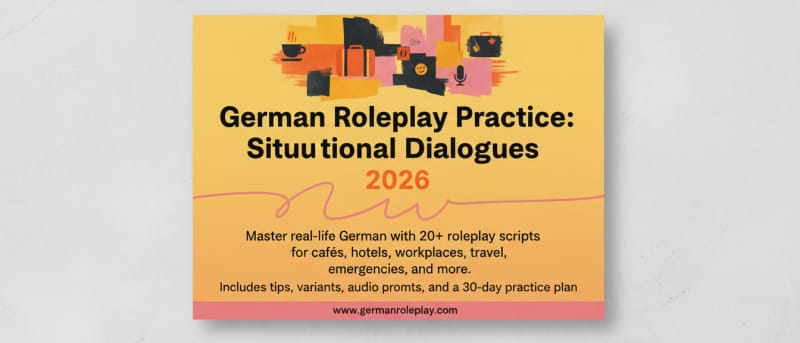
Learn German Through Roleplay: Speak Confidently in Every Situation
Roleplay is one of the fastest ways to turn classroom German into real conversations. You act out everyday situations, experiment with phrases, and build muscle memory—so when you’re in Germany, the words flow naturally. This guide gives you complete roleplay scripts, level variations, pronunciation tips, and a 30-day training plan.
How to use this guide:
- Pick a scenario relevant to your life (café, hotel, workplace, doctor, etc.).
- Shadow the sample dialogue, paying attention to pronunciation and rhythm.
- Switch roles, improvise new responses, and record yourself.
- Use the “Add complications” prompts to keep the dialogue flexible.
- Follow the practice plan and track your progress.
Table of Contents
- 1. Why Roleplay Works
- 2. Roleplay Setup & Tips
- 3. Starter Phrases for Every Conversation
- 4. Beginner Scenarios (A1–A2)
- 5. Intermediate Scenarios (B1–B2)
- 6. Advanced Scenarios (C1)
- 7. Roleplay Variations & Complications
- 8. Pronunciation & Body Language Tips
- 9. Pair Practice vs. Solo Practice
- 10. 30-Day Roleplay Challenge
- 11. Downloadables & Resources
- 12. FAQs & Next Steps
1. Why Roleplay Works
- Realistic practice: You apply grammar and vocabulary in context.
- Confidence boost: You rehearse conversations safely before real life.
- Pronunciation & rhythm: Repetition strengthens natural speech patterns.
- Listening skills: You train your ear for common responses.
2. Roleplay Setup & Tips
- Use a timer: practise for 10–15 minutes daily.
- Prepare props: menus, tickets, receipts, forms.
- Record both roles—listen back for pronunciation and fillers (“ähm”, “also”).
- Switch partners: practise with friends, tutors, or language exchange partners.
- Use background sounds (YouTube ambiance) to add realism.
3. Starter Phrases for Every Conversation
- Greetings: Guten Tag, Hallo, Guten Abend.
- Politeness: Bitte, danke, gerne, Entschuldigung, Könnten Sie…?
- Clarification: Könnten Sie das wiederholen? Langsam, bitte.
- Transition: Also…, Zuallererst…, Übrigens…, Eine Frage hätte ich noch…
- Closing: Vielen Dank! Einen schönen Tag noch! Auf Wiedersehen!
4. Beginner Scenarios (A1–A2)
Scenario: Café Bestellung
Kunde: Guten Tag! Ich hätte gerne einen Cappuccino und ein Stück Kuchen.
Kellnerin: Gerne. Möchten Sie den Cappuccino mit oder ohne Zucker?
Kunde: Ohne Zucker, bitte. Kann ich mit Karte zahlen?
Kellnerin: Ja, natürlich. Das macht 6,80 Euro.
Variationen:
- Sie möchten vegetarische Optionen erfragen.
- Der Kellner versteht Sie nicht sofort (wiederholen).
- Sie reklamieren, dass das Getränk zu heiß ist.
Scenario: Hotel Check-in
Gast: Guten Abend, ich habe eine Reservierung auf den Namen Schmidt.
Rezeptionist: Einen Moment bitte… Ja, hier ist sie. Möchten Sie ein Zimmer mit Frühstück?
Gast: Ja, bitte. Gibt es WLAN im Zimmer?
Rezeptionist: Ja, der Code steht auf der Schlüsselkarte.
Variationen:
- Fragen Sie nach einem späten Check-out.
- Bitten Sie um ein ruhiges Zimmer.
- Reklamieren Sie, dass das Zimmer noch nicht fertig ist.
Scenario: Einkaufen
Kunde: Entschuldigung, wie viel kostet dieser Pullover?
Verkäuferin: Er kostet 39,90 Euro. Er ist gerade im Angebot.
Kunde: Gibt es ihn auch in Größe M?
Verkäuferin: Ich schaue nach… Ja, hier bitte.
Variationen:
- Fragen Sie nach Rückgabebedingungen.
- Handeln Sie einen Rabatt heraus (auf Flohmärkten).
- Bestellen Sie online; fragen Sie nach Versand.
5. Intermediate Scenarios (B1–B2)
Scenario: Arzttermin
Patient: Guten Tag, ich habe seit zwei Tagen Fieber und Kopfschmerzen.
Ärztin: Haben Sie noch weitere Symptome? Zum Beispiel Husten oder Schüttelfrost?
Patient: Ja, ein leichter Husten und Müdigkeit.
Ärztin: Ich verschreibe Ihnen ein Medikament. Bitte ruhen Sie sich aus und trinken Sie viel.
Variationen:
- Nach Impfungen oder Überweisungen fragen.
- Krankmeldung für die Arbeit/Uni verlangen.
- Verständnisprobleme (bitten Sie um vereinfachte Erklärung).
Scenario: Bewerbungsgespräch
Interviewer: Erzählen Sie uns etwas über Ihre bisherigen Erfahrungen.
Kandidat: Ich habe zwei Jahre im Projektmanagement gearbeitet und internationale Teams koordiniert.
Interviewer: Warum möchten Sie bei uns arbeiten?
Kandidat: Ihr Unternehmen entwickelt innovative Lösungen, und ich möchte daran mitwirken.
Variationen:
- Gehaltsverhandlungen üben.
- Auf kritische Fragen reagieren (“Was sind Ihre Schwächen?”).
- Networking-Smalltalk vor oder nach dem Gespräch.
Scenario: Mitbewohnergespräch
Mitbewohner A: Können wir bitte die Haushaltsliste überarbeiten? Ich putze oft, aber die Küche bleibt unordentlich.
Mitbewohner B: Oh, das tut mir leid. Lass uns einen Plan machen: Montag/Woche A bin ich dran, du Donnerstag/Woche B.
Mitbewohner A: Super, und vielleicht sammeln wir die Pfandflaschen gemeinsam.
6. Advanced Scenarios (C1)
Scenario: Geschäftspräsentation
Moderator: Guten Morgen zusammen. Heute präsentiere ich Ihnen unsere Quartalszahlen und den Ausblick.
Kollegin: Könnten Sie genauer erklären, wie sich die steigenden Energiepreise auswirken?
Moderator: Natürlich. Wir planen, unsere Lieferketten umzustellen, um Kosten zu reduzieren.
Scenario: Streitbeilegung
Kollege A: Ich finde, dein Kommentar im Meeting war unpassend.
Kollege B: Entschuldige, das war nicht meine Absicht. Lass uns besprechen, wie wir in Zukunft besser kommunizieren können.
Scenario: Behördenbesuch
Bürger: Guten Tag, ich möchte meinen Wohnsitz ummelden. Welche Unterlagen benötigen Sie?
Sachbearbeiterin: Wir brauchen Ihren Ausweis, den Mietvertrag und das ausgefüllte Formular.
Variationen: Formulare fehlen, Termine verpasst, höfliche Beschwerden.
7. Roleplay Variations & Complications
- Time pressure: simulate being late, needing quick answers.
- Noise distraction: play background sounds (train station, busy café).
- Emotions: practise apologising, expressing surprise, complaining politely.
- Regional accents: incorporate vocabulary from Berlin, Bavaria, Cologne.
8. Pronunciation & Body Language Tips
- Practice intonation for questions vs statements.
- Use gestures—Germans appreciate direct eye contact during conversation.
- Adopt filler words: “ähm, also, na ja, genau, stimmt.”
- Record yourself and compare to native audio for rhythm.
9. Pair Practice vs. Solo Practice
Pair: Alternate roles, give each other feedback, add unexpected twists (lost passport, sold-out tickets).
Solo: Read both roles aloud, change voice/pitch, respond spontaneously as if hearing the other person.
10. 30-Day Roleplay Challenge
Commit to one roleplay per day (10–15 minutes). Rotate topics to build versatility.
- Café
- Bakery
- Supermarket
- Pharmacy
- Doctor
- Post office
- Train station
- Hotel check-in
- Business meeting
- Job interview
- Apartment viewing
- Landlord conversation
- Talking to neighbours
- Emergency call
- Restaurant reservation
- Asking for directions
- Gym membership
- University registration
- Library membership
- Small talk at party
- Birthday invitation
- Booking a tour
- Complaint letter
- Arguing a bill
- Overcoming misunderstandings
- Negotiating price
- Giving feedback
- Farewell speech
- Talking about hobbies
- Review reflection
11. Downloadables & Resources
- Printable roleplay cards (cut-out prompts).
- Audio playlist with sample dialogues (slow + natural speed).
- Feedback sheet (fluency, vocabulary, pronunciation scores).
- Checklist for realistic props (tickets, menus, forms).
12. FAQs & Next Steps
Where can I find roleplay partners?
Join Tandem, italki community sessions, local Stammtisch groups, or Discord servers for German learners.
Does roleplay replace grammar study?
No—but it reinforces grammar in context. Combine with targeted study to solidify rules.
What if I don't know the right word during roleplay?
Use circumlocution: describe what you mean. Then note the missing word and learn it afterwards.
Conclusion: Practise Now, Speak Naturally Later
Roleplay bridges the gap between theory and reality. By rehearsing daily scenarios, you train your brain to think and respond in German quickly. Pick a script today, record yourself, and repeat tomorrow. In a few weeks, you'll notice smoother conversations in real life.
Next step: Choose a scenario from the list, invite a friend or tutor, and start roleplaying. Share your best improvisation with others—it’s fun and super effective.
To deepen your roleplay practice, combine this guide with our speaking tips and listening tips. For more dialogue ideas, use the small talk, daily speaking, and speaking challenge guides, or work on conversation flow and grammar so your scripts sound natural. More practice: practice tests, A2 and B1 tests, and all learning resources.
Official sources & references
Authoritative sources for language levels and life in Germany cited in this guide. All links verified.