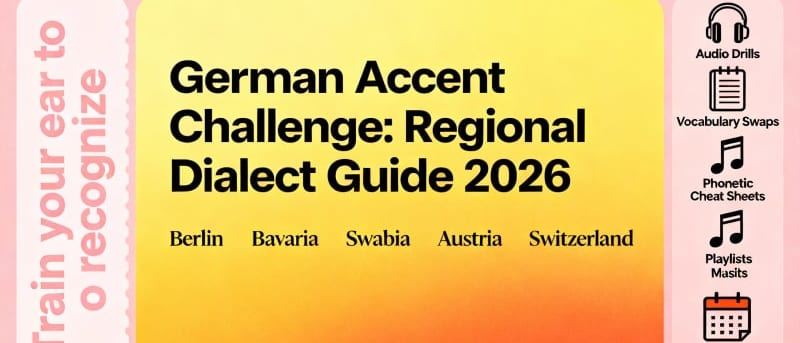
German Accent & Dialect Challenge: Complete Ear Training Guide for Regional German
Standard German (Hochdeutsch) is just the beginning. Germany, Austria, and Switzerland offer a rich soundscape of accents, dialects, and regional slang that can surprise even advanced learners. If you want to understand conversations in Berlin, Munich, Vienna, or Zurich—and sound more natural yourself—ear training is essential. This challenge guide, curated by accent coach Robert Schulz, walks you through the most important regional varieties, common pronunciation shifts, vocabulary differences, and daily listening routines so you can identify dialects with confidence.
Use this content as a systematic training plan. Follow the headphone icon markers for listening drills, test yourself with checklists, and build your own playlist to revisit regularly.
What You Will Learn
- Profiles of the major accent groups: Berlin, Bavaria, Swabia, Rhineland, Austria, Switzerland, and North Germany.
- Key pronunciation features and phonetic cheat sheets for each region.
- Signature vocabulary and idioms with standard German equivalents.
- Audio resources, podcasts, and YouTube channels for targeted ear training.
- Shadowing scripts, minimal pair drills, and recording prompts.
- Interactive challenges: identify the dialect, fill in missing lyrics, and decode conversations.
- 30-day accent immersion plan with daily tasks.
Table of Contents
- 1. Why Train Your Ear for Dialects?
- 2. Accent vs. Dialect: Terminology Guide
- 3. Map of German-Speaking Regions
- 4. Berlin & Northern German: Clear but Casual
- 5. Bavaria & Austria: Vowel Shifts and Rolling Rs
- 6. Swabia & Alemannic Regions: Soft Consonants and Unique Grammar
- 7. Rhineland & Cologne: Musical Intonation
- 8. Saxony & Thuringia: s/z and diphthong changes
- 9. Swiss German: Distinct Dialect Family
- 10. Vocabulary Swaps by Region
- 11. Listening Resources & Playlists
- 12. Shadowing, Dictation, and Mimicry Drills
- 13. Dialect Challenge Games
- 14. 30-Day Accent Immersion Plan
- 15. Using Dialects in Conversation: Dos & Don’ts
- 16. Exam & Professional Scenarios
- 17. FAQ & Next Steps
1. Why Train Your Ear for Dialects?
German learners often feel lost outside classroom audio. Dialects change pronunciation, vocabulary, and even grammar patterns. Ear training helps you:
- Understand locals: navigate everyday conversations without constant “Wie bitte?”
- Build cultural empathy: appreciate regional identity and humor.
- Improve pronunciation: mimic natural rhythm and intonation.
- Pass listening exams: exam audio often includes regional accents.
- Travel with confidence: adjust quickly to new environments.
2. Accent vs. Dialect: Terminology Guide
- Akzent: Pronunciation differences while grammar and vocabulary remain mostly standard.
- Dialekt: Distinct vocabulary, grammar forms, and pronunciation—sometimes mutually unintelligible with standard German.
- Umgangssprache: Everyday informal speech mixing standard and regional features.
- Regiolekt: Regional variant approximating standard German with local flavor (e.g., Ruhrdeutsch).
3. Map of German-Speaking Regions
German dialectology generally divides into three major groups:
- Niederdeutsch (Low German): Northern Germany. Closer to Dutch historically; modern version mostly accent with few grammar differences.
- Mitteldeutsch (Central German): Berlin, Saxony, Thuringia, Rhineland. Influences standard German strongly.
- Oberdeutsch (Upper German): Bavaria, Swabia, Austria, Switzerland. Largest vowel shifts and grammar differences.
Within each zone are micro-regions with unique features. This guide focuses on the most frequently encountered accents.
4. Berlin & Northern German: Clear but Casual
Pronunciation Traits
- Hard g → j sound: gut → jut, Geige → Jeije.
- Final -ig pronounced as -ick: wichtig → wichtick.
- ß pronounced like strong “s” (no lisp).
- Drop of final -e: habe → hab, eine → eene (colloquial).
- Tonal pattern: often flat, with shortened vowels.
Vocabulary Highlights
- „Bemme“ or „Stulle“ for Sandwich/Brot.
- „Späti“ (late-night convenience store).
- „Kiez“ (neighborhood).
- „Jibt keen Problem“ (no problem).
Listening Resources
- Podcast: „Radio Fritz – Berlin Live“.
- YouTube: „36grad Berlin“, „Digga – Berlin Stories“.
- Music: Seeed, Peter Fox for Berlin slang.
Drill
Repeat sentences substituting g → j: „Gut, dass du gekommen bist.“ → „Jut, dass du jejommen bist.“ Record and compare with Berlin speakers.
5. Bavaria & Austria: Vowel Shifts and Rolling Rs
Pronunciation Traits
- „ei“ → „oa“: eins → oans, Zeit → Zoit.
- „p“ → „b“, „t“ → „d“, „k“ → „g“ in casual speech.
- Rolling or trilled r, especially before vowels.
- Shortened endings: „einmal“ → „amoi“, „haben“ → „ham“.
Vocabulary Highlights
- „Servus“ (hello/goodbye), „Grüß Gott“ (greeting).
- „Semmel“ (Brötchen), „Obazda“ (cheese spread), „Knedl“ (dumpling).
- „Gaudi“ (fun), „Bua/Madl“ (boy/girl).
- „Heuer“ (this year) in Austria.
Listening Resources
- TV: „ServusTV Nachrichten“, „Bayern 3 – Frühaufdreher“.
- Podcasts: „Bayern Insider“, „Erzähl mir von Wien“.
- YouTube: „München TV – Wir in Bayern“, „Austrian German with Konstantin“.
Drill
Practice mini-dialogues replacing vowels: „Ich weiß nicht“ → „I woaß ned“. Try reading Bavarian lyrics (for example, „So ein schöner Tag“ Alpenrebellen).
6. Swabia & Alemannic Regions: Soft Consonants and Unique Grammar
Pronunciation Traits
- „st“ → „schd“ and „sp“ → „schb“: Straße → Schdrooß, Sport → Schbort.
- Shortened „ei“ → „â“ or „e“: Zeit → „Zeid“.
- „ch“ becomes a softer „sch“ or „kch“ sound.
- Sentence melody rising at the end.
Vocabulary Highlights
- „Grüßle“ (greetings), „Le“ (diminutive for names—Sabbele for Sabine).
- „Äbbes“ (something), „gell?“ (right?), „Schaffe“ (work).
- „Spätzle“, „Maultaschen“ culinary references show up frequently.
Grammar Quirks
- Use of „net“ for „nicht“.
- Occasional double negation for emphasis.
- Alternative verb endings (-et instead of -t).
Listening Resources
- Radio: SWR4, SWR Heimat Podcasts.
- YouTube: „Äffle & Pferdle“ cartoons, „Schwäbisch Coaching“.
- Comedy: Christoph Sonntag, Dodokay, Hannes und der Bürgermeister.
7. Rhineland & Cologne: Musical Intonation
Pronunciation Traits
- „ich“ → „isch“, „nicht“ → „nit“.
- Melodic rising-falling intonation resembling singing.
- Softening of consonants, smoothing of vowels.
Vocabulary Highlights
- „Kölle“ for Köln, „Bützje“ (kiss), „Alaaf“ (Carnival greeting).
- „Jebützt“ (kissed), „lecker“ used for nice/pretty.
- „Loss jonn!“ (let´s go).
Listening Resources
- TV: WDR Lokalzeit Köln.
- Podcast: „Kölner Treff“, „Talk mit K“.
- Music: Höhner, Bläck Fööss, Kasalla (Carnival songs).
8. Saxony & Thuringia: s/z and Diphthong Changes
Pronunciation Traits
- „s“ and „z“ pronounced as „sch“ in some positions: „Sonne“ → „Schonne“.
- „ei“ → „ai“ sound closer to „ais“.
- „k“ softened towards „ch“ in some words.
- Distinct rhythm with elongated vowels.
Vocabulary Highlights
- „Nu“ for „na gut/also“, „Feierabend“ strongly pronounced.
- „Guggsdu“ for „schaust du“ (Do you see?).
- „Semmel“ also appears; „Bemme“ for sandwiches.
Listening Resources
- Podcast: MDR Sachsen „Das Wort zum Montag“.
- YouTube: „Sächsisch tutorial“ by Tom Pauls.
- Comedy: Olaf Schubert, Uwe Steimle.
9. Swiss German: Distinct Dialect Family
Swiss German (Schweizerdeutsch) differs significantly from standard German. While Swiss people usually switch to Hochdeutsch for formal situations, understanding the dialect helps with daily life, especially in Zurich, Bern, Basel.
Pronunciation Traits
- „k“ becomes „ch“ or hard „kch“: Kind → Chind.
- No „ß“—always „ss“.
- Strong diphthongs and unique rhythm.
- „r“ often guttural like standard German, sometimes rolled depending on region.
Vocabulary Highlights
- „Grüezi“ (greeting), „Merci vielmal“, „Velo“ (bicycle), „Znüni“ (mid-morning snack), „Guete Morge“.
- „Fröit mi“ (pleased to meet you), „Lädele“ (shopping), „Chuchichäschtli“ (kitchen cupboard—famous tongue-twister).
Grammar Notes
- Past tense uses perfect almost exclusively.
- Different pronouns: „mir“ for „wir“, „Euses“ for „unser“.
- Double negation common for emphasis.
Listening Resources
- TV: SRF News, SRF Kids.
- Podcasts: „Deville Podcast“, „SRF 3 Input“ (mixed Standard and dialect).
- YouTube: „Switzerland Tourism“, „Mundart Serie – SRF bi de Lüt“.
- Language courses: „Hallo Schweiz“ (Swissinfo), „Swiss German for Beginners“ (podcasts).
10. Vocabulary Swaps by Region
| Item |
Standard |
Berlin |
Bavaria/Austria |
Swabia |
Rhineland |
Switzerland |
| Roll (bread) |
Brötchen |
Schrippe |
Semmel |
Weckle |
Brötchen |
Weggli |
| Bread spread |
Belag |
Schmiere |
Aufstrich/Schmarrn |
Schmier |
Aufschnitt |
Uufstrich |
| Bike |
Fahrrad |
Rad |
Radl |
Velo |
Rad |
Velo |
| Kid |
Kind |
Göre |
Dirndl/Bua |
Bua/Meadle |
Pänz |
Chind |
Build flashcards grouping synonyms by region. These associations speed up comprehension when locals use dialect terms unexpectedly.
11. Listening Resources & Playlists
Create your own accent playlist:
- Collect short clips (30-90 seconds) from recommended sources.
- Label them by region; include transcripts when available.
- Practice identifying accents blind—shuffle playlist and guess region before checking notes.
- Use platforms like LingQ or Language Reactor to manage transcripts.
Sample playlist starters: DW „Dialektatlas“, WDR „So klingt Deutschland“, BR Heimat podcasts, SRF Dialekt-Challenges, YouTube „Dialect Coach tries to identify German accents“.
12. Shadowing, Dictation, and Mimicry Drills
Active imitation trains your ear and mouth simultaneously.
- Shadowing: Repeat sentences simultaneously with the speaker. Focus on rhythm and melody before perfect pronunciation.
- Echoing: Pause after each sentence and repeat. Slow down playback as needed.
- Dictation: Transcribe short dialect clips, then compare with transcript. Highlight unfamiliar spellings.
- Minimal pair practice: Create pairs with accent differences (Standard „nicht“ vs. Cologne „nit“). Drill until you can distinguish them at speed.
- Recording & feedback: Mimic a short clip, record yourself, and share with a tutor or friend from that region.
13. Dialect Challenge Games
Guess the Region
- Pick five audio clips (10 seconds each) from different regions.
- Listen blindfolded or with screen hidden.
- Write down guess + cues (g→j? rolling r?).
- Check answers and note signature clues.
Fill the Blank
- Remove key dialect words from transcripts. Try to fill them using context. Example: „Ich geh gleich ___ (Bavarian: hoam).“
Dialect Bingo
- Create a bingo sheet with features (rolled r, nit, servus, chind). Tick boxes while watching content. Aim for 5-in-a-row each week.
14. 30-Day Accent Immersion Plan
Follow this schedule to build recognition gradually.
- Week 1: Berlin & North. Listen to Easy German Berlin episodes, practice g→j shifts.
- Week 2: Bavaria & Austria. Watch ServusTV news, mimic greetings, note vocabulary in a table.
- Week 3: Swabia & Rhineland. Alternate between SWR clips and Cologne Carnival songs. Practice schd/schb and melodic intonation.
- Week 4: Switzerland + wild card (Saxony). Shadow Swiss German dialogues, compare to Saxon clips. Complete final quiz identifying 10 random clips.
Log each day: resource, minutes, one pronunciation feature, one new vocabulary word, rating of difficulty.
15. Using Dialects in Conversation: Dos & Don’ts
- Do mirror small features (servus, nit) when speaking with locals, but keep sentences mostly in standard German until you are comfortable.
- Do ask for repetition politely (Könntest du das bitte auf Hochdeutsch sagen?). Most speakers will gladly adjust.
- Don’t overuse dialect words if you are unsure of context—they can sound odd or comedic unintentionally.
- Don’t mimic accent stereotypes; focus on respectful imitation.
16. Exam & Professional Scenarios
Many advanced exams include regional audio. Prepare by:
- Using Goethe C1/C2 sample audio to identify accents.
- Practicing note-taking from Tagesschau segments featuring guest interviews.
- Recording yourself summarizing dialect segments into standard German to prove comprehension.
- Learning polite phrases for meetings (Darf ich kurz nachfragen? Ich bin nicht sicher, ob ich das richtig verstanden habe.).
17. FAQ & Next Steps
Do I need to speak dialects?
No. Aim for recognition first. Passive understanding unlocks conversations even if you respond in standard German.
How fast should I transition to harder accents?
Build gradually. Once you can identify features in Berlin accent comfortably, add Bavarian, then Swiss. Rotate weekly but maintain review sessions.
What if I feel overwhelmed?
Focus on one region per week. Limit training to 15 minutes per day. Use transcripts and slow playback. Celebrate small victories (recognizing a single word or drop of final -e).
Conclusion: Turn Accents into Advantage
German accents are gateways to culture, humor, and deeper connections. By training your ear with structured playlists, active drills, and fun challenges, you eliminate the fear of “not understanding” outside textbook German. Embrace the variety—each dialect teaches you new sounds, new vocabulary, and new ways of expressing personality.
Next step: Download the audio playlist, choose one region to focus on this week, and complete the “Guess the Region” challenge. Record your guesses, share them with a friend, and compare notes. In 30 days, revisit the first clips—you will be amazed at how much more you can hear.
Ear training fits naturally with other skills. Once you can spot regional features, our regional accents guide and pronounce like a Berliner help you go deeper on specific varieties and clean up your own pronunciation. For listening stamina and real-world input, pair this with the listening boosters guide and news listening playbook—both use similar drill ideas. If you want to turn recognition into speaking, the conversation flow guide and daily speaking routine focus on rhythm and natural phrasing; our speaking tips and listening tips add more by skill.
Official sources & references
Authoritative media and exam sources for dialect and accent training cited in this guide. All links verified.