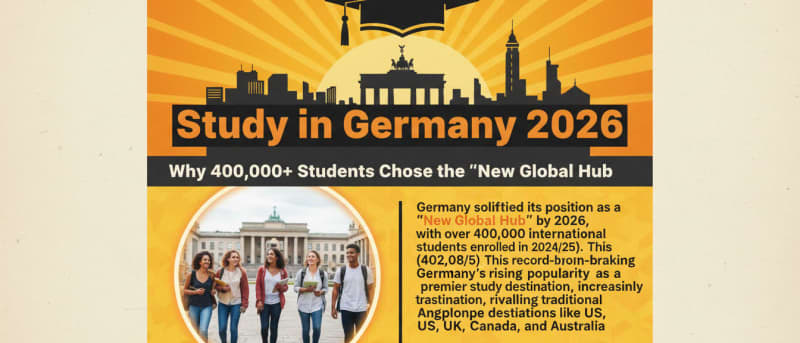
Study in Germany 2026: Why 400,000+ Students Chose the "New Global Hub"
Breaking News: Germany solidified its position as a "New Global Hub" by 2026, with over 400,000 international students enrolled in its higher education institutions. This record-breaking enrollment (specifically 402,083 in the 2024/25 winter semester) reflects Germany's rising popularity as a premier study destination, increasingly rivaling traditional Anglophone destinations like the US, UK, Canada, and Australia.
News Hook: Record-Breaking Enrollment in 2026
In 2026, Germany confirmed its status as a premier global education hub, with international enrollment reaching a record 402,083 students in the 2024/25 winter semester. Projections by the German Academic Exchange Service (DAAD) for the 2025/26 winter semester even suggest this figure could rise further to 420,000 students, demonstrating sustained growth in Germany's appeal as a study destination.
Record-Breaking Enrollment Data (2024/25 Winter Semester)
Total International Students: Over 402,000
Just over 402,000 international students and doctoral candidates were enrolled in German higher education institutions. This represented a nearly 6% increase from the previous academic year, continuing a decade-long trend of sustained growth in international student enrollment.
Record New Intake: 116,600 First-Year Students
The number of international first-year students reached a record high of 116,600, marking a peak in new foreign enrollment. This represents the highest number of new international students ever recorded in a single academic year in Germany.
India Surpasses China as Top Source Country
India emerged as the largest source country, with nearly 59,000 students (a 20% year-on-year increase), surpassing China which followed in second place with approximately 38,600 students. This shift represents a significant change in the demographic composition of international students in Germany.
Field of Study Distribution
The majority of students (43%) were enrolled in Engineering and Natural Sciences, followed by Economics, Law, and Social Sciences at 25%. This distribution reflects Germany's strength in STEM fields and its appeal to students seeking career-oriented degrees.
Global Ranking: Third Most Popular Destination
Germany became the third most popular study destination in the world for international students, and the most popular non-English-speaking host country. This achievement positions Germany alongside traditional powerhouses like the United States and United Kingdom in global higher education.
High Retention Rate
Roughly two-thirds of international students in Germany intend to stay and work after graduation, demonstrating the country's appeal not just as a study destination but as a long-term career destination.
Reasons for Rising Popularity Over Traditional Destinations
Germany's appeal stems from a combination of affordability, high-quality education, and favorable post-study prospects, which contrasts with the affordability and visa challenges faced by some traditional destinations.
Affordable/Tuition-Free Education
Most public universities in Germany do not charge tuition fees for international students, requiring only a small semester contribution (typically €150-€400) to cover administration and public transit. This makes Germany significantly more affordable than the US, UK, or Australia, where annual tuition can exceed €20,000-€40,000.
High-Quality, Globally Recognized Degrees
German universities are renowned for strong academic standards, research, and innovation, and their degrees are highly respected by employers worldwide. The country's emphasis on research and practical application ensures graduates are well-prepared for the global job market.
Strong Economy and Career Prospects
As Europe's largest economy, Germany offers a robust job market, particularly in high-demand sectors like engineering, IT, and healthcare. The country's strong industrial base and innovation ecosystem provide excellent career opportunities for graduates.
Generous Post-Study Work Options
Graduates can apply for an 18-month job-seeker visa, giving them ample time to find relevant employment and a pathway to permanent residency. This is a major draw compared to countries with stricter timelines. Additionally, Germany now offers expanded dual citizenship and a standard five-year naturalization pathway, making long-term settlement more accessible.
English-Taught Programs
The increasing availability of English-taught master's and a growing number of bachelor's programs (nearly 2,400 in summer 2025, including roughly 1,930 at the Master's level) has lowered language barriers for non-German speakers, making German education accessible to a broader international audience.
Affordable Cost of Living
The cost of living is considered reasonable compared to many other major study-abroad locations, with students budgeting between €850 and €1,200 per month, depending on the city. Students are permitted to work part-time (up to 120 full days or 240 half days per year) to help cover expenses, further enhancing affordability.
Financial and Visa Requirements for 2026
Blocked Account Increase
As of 2026, the required amount for a blocked bank account to secure a student visa has risen to at least €11,904 per year. This amount ensures students have sufficient funds to cover living expenses during their first year of study in Germany.
Semester Fees
Public universities remain virtually tuition-free, though students pay a mandatory semester contribution typically ranging from €150 to €400 to cover administration, student services, and public transit passes (Semesterticket), which provides significant value.
Monthly Living Costs
On average, students should budget between €850 and €1,200 per month, depending on the city. Larger cities like Munich and Frankfurt tend to be more expensive, while smaller university towns offer more affordable living costs.
Key Drivers of Popularity
Post-Study Opportunities
Graduates benefit from an 18-month job-seeker visa, with expanded dual citizenship and a standard five-year naturalization pathway now available. New initiatives like "Academic Horizons – Attracting Global Minds" (launched January 2025) specifically target talent in AI and climate-neutral mobility, creating additional opportunities for graduates.
English-Taught Growth
By summer 2025, German universities offered nearly 2,400 English-language degree programs, including roughly 1,930 at the Master's level. This expansion has made German education more accessible to international students who may not speak German fluently.
Career Integration
Programs are designed with industry collaboration, and new initiatives specifically target talent in high-demand sectors like AI and climate-neutral mobility. This ensures graduates are well-prepared for Germany's evolving job market and can transition smoothly from study to employment.
Comparison: Germany vs. Traditional Study Destinations
| Aspect |
Germany |
US/UK/Canada/Australia |
| Tuition Fees |
Tuition-free (€150-€400 semester contribution) |
€20,000-€40,000+ per year |
| Annual Cost |
€10,200-€14,400 (living costs) |
€25,000-€50,000+ (tuition + living) |
| Post-Study Work Visa |
18 months |
Varies (often shorter) |
| Pathway to PR |
5-year naturalization |
Varies (often longer/more complex) |
| English Programs |
2,400+ programs |
Extensive |
| Job Market |
Strong (Europe's largest economy) |
Strong |
| Global Ranking |
3rd most popular, #1 non-English |
Top positions |
Top Source Countries for 2026
Leading Origins
- India: Nearly 59,000 students (20% year-on-year increase) - #1 source country
- China: Approximately 38,600 students - #2 source country
- Other Asian Countries: Significant representation from countries like Bangladesh, Pakistan, and Vietnam
- European Countries: Strong representation from EU member states
- Middle East & Africa: Growing numbers from these regions
What This Means for Prospective Students
For students considering studying in Germany:
- Affordable Education: Tuition-free public universities make Germany one of the most affordable study destinations
- Quality Education: Globally recognized degrees from renowned institutions
- Career Opportunities: Strong job market in high-demand sectors
- Post-Study Options: 18-month job-seeker visa and pathway to permanent residency
- Growing Community: Large and diverse international student community
- English Accessibility: Nearly 2,400 English-taught programs available
Quick Start: What Students Need to Know
If you're considering studying in Germany:
- Research Programs: Explore the nearly 2,400 English-language programs available
- Financial Preparation: Prepare €11,904 for blocked account (2026 requirement)
- Check Requirements: Verify academic qualifications, language proficiency (if required), and admission criteria
- Apply Early: Deadlines vary by university (typically July 15 for Winter Semester)
- Plan Living Costs: Budget €850-€1,200 per month depending on city
- Consider Post-Study: 18-month job-seeker visa provides ample time to find employment
Important Notes:
- Germany is the 3rd most popular study destination globally, #1 non-English-speaking country
- 402,083 international students enrolled in 2024/25 winter semester (projected 420,000 for 2025/26)
- India is now the top source country with 59,000 students (20% increase)
- 43% of students study Engineering and Natural Sciences, 25% study Economics/Law/Social Sciences
- Two-thirds of international students intend to stay and work after graduation
- Most public universities remain tuition-free, requiring only €150-€400 semester contribution
- Blocked account requirement is €11,904 for 2026 (increased from previous years)
Official Sources (One-Click Links)
-
DAAD – International Students in Germany 2024/25 Statistics
https://www.daad.de
(Official press release confirming the record 402,083 international students and the 420,000 forecast for 2026)
-
Wissenschaft weltoffen – 2025 Data on Foreign Students
https://www.wissenschaft-weltoffen.de
(Comprehensive report verifying that India has surpassed China with 59,000 students and the 43% STEM enrollment rate)
-
Auswärtiges Amt – Student Visa Financial Requirements 2026
https://www.auswaertiges-amt.de
(Federal Foreign Office confirmation of the €11,904 blocked account mandate for the 2026 academic year)
-
DAAD – International Programmes Database (English-Taught)
https://www2.daad.de
(Official database to verify the availability of nearly 2,400 English-taught degree programs for the 2026 intake)
-
Make it in Germany – The 18-Month Job-Seeker Visa
https://www.make-it-in-germany.com
(Government portal explaining the post-study work rights and the path to the 5-year naturalization standard)
-
BMBF – Academic Horizons Initiative
https://www.bmbf.de
(Ministry of Education guide on the 'Attracting Global Minds' strategy targeting AI and climate-neutral mobility talent)
Last checked: February 2026.