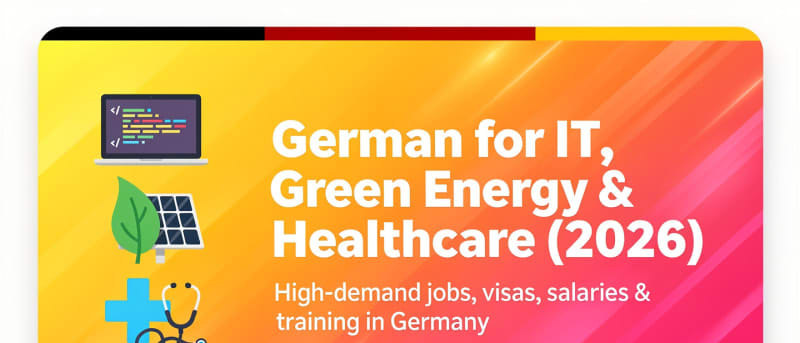
German for Specific Purposes: Technical German for IT, Green Energy, and Healthcare Professionals (2026)
In 2026, many employers in Germany expect more than general B1/B2: they want technical and sector-specific German—for IT, green energy, healthcare, and engineering. Demand for skilled workers remains high in these fields, and language programmes are increasingly tailored to industry vocabulary, certifications, and workplace tasks. This guide outlines why specialised German matters, which sectors to target, and where to find training and exams.
What this means for you
Build a
general B1/B2 base first, then add
industry-specific German: medical communication and documentation for healthcare; technical vocabulary for IT (e.g. software, AI, data, security) and green energy (e.g. hydrogen, wind, solar, grid). For
nursing, the
telc Deutsch B2 Pflege (or B1·B2 Pflege) is often required. For
IT, salary thresholds for the
EU Blue Card in 2026 are €50,700 (standard) or €45,934 for shortage occupations. The
Opportunity Card (Chancenkarte) allows job search in Germany (e.g. A1 German or B2 English, points-based). Use
Goethe-Institut and
DAAD for course and exam options.
Why Sector-Specific German Matters
General German gets you through daily life; technical German gets you through job interviews, documentation, and teamwork in your field. In regulated professions (e.g. healthcare, some engineering), proof of specialised language is often required for Approbation or licensing. In IT and green energy, it signals that you can work in German-speaking teams and with German-language standards and documentation.
Three High-Demand Sectors (2026)
Healthcare and nursing
Healthcare continues to hire heavily; many roles require B2 (or higher) plus clinical German—patient communication, documentation, digital health and telemedicine terms. For nurses, the telc Deutsch B2 Pflege (or telc Deutsch B1·B2 Pflege) is the standard language exam. Training often covers physician–patient communication, clinical writing, and patient-centred communication for nursing staff. DAAD-listed programmes and specialised “German for Medical Purposes” or “Triple Win”–style pathways exist; check current dates and entry requirements.
Green energy and technology
The Energiewende (energy transition) drives demand for workers in wind, solar, hydrogen, grid storage, and green construction. Technical German for these roles includes: hydrogen and battery terminology, wind and solar O&M (operations and maintenance), climate-friendly construction, and energy-efficient tech. Providers such as the Renewables Academy (RENAC) in Berlin offer certificate courses in energy policy and green energy; sector events (e.g. trade fairs, conferences) give practice in technical discourse. Certification bodies (e.g. TÜV Rheinland for green hydrogen) sometimes link with training; check their current requirements.
IT and technology
IT shortages persist; employers look for German that can handle software, AI, data, cybersecurity, and cloud. Focus areas: algorithms and machine learning, software development and security, data engineering, and “Digital GreenTech” where IT meets sustainability. Universities and language institutes (e.g. DAAD partner institutions, IIK Düsseldorf) offer “German for Engineers and Technicians” or similar—technical vocabulary, manual comprehension, professional documentation. Salary bands in 2026 for roles like software development, cybersecurity, and AI/ML are often in the €55,000–€110,000+ range depending on role and experience.
Training and Certification
- Healthcare: telc Deutsch B2 Pflege or B1·B2 Pflege; Goethe B2 is often accepted for general proficiency; specialised medical German courses and DAAD-listed programmes for clinical communication and writing.
- Green energy: RENAC and similar providers for certificates in energy policy and green energy; link language learning to industry certifications (e.g. TÜV) where relevant.
- IT/engineering: “German for Engineers and Technicians” and technical German courses at DAAD-partner universities and language institutes; focus on manuals, documentation, and professional communication.
Use placement tests (e.g. from publishers or test providers) to confirm your level before choosing a specialised course. Many programmes expect at least B1 or B2 general German before adding technical content.
Practical Steps
- Assess your level: Solid B1/B2 general German first; then add sector-specific work.
- Choose your niche: Nursing → telc Pflege and medical German; IT → technical German for engineers; Green → energy and sustainability vocabulary and certificates.
- Use specialised input: Sector podcasts, technical journals, and materials from bodies like the German Environment Agency (UBA) or professional associations.
- Combine language and certification: Where your profession has recognised certs (e.g. TÜV, clinical exams), look for programmes that prepare you for both.
- Practise in context: Conferences, trade fairs, and online events to use technical German in real scenarios.
Visa note
For IT and other skilled work, the EU Blue Card in 2026 requires a gross annual salary of €50,700 (or €45,934 for shortage occupations). The Opportunity Card (Chancenkarte) allows job search in Germany for up to one year (e.g. A1 German or B2 English, points-based). See Make it in Germany for current requirements.
Reference (Official and Recognised Resources)
For courses, exams, and visas:
Last checked: February 2026.
Next Steps
Confirm your general level (B1/B2), then choose one sector and one concrete goal (e.g. telc B2 Pflege, technical German for IT, or an energy certificate). Book a placement test if needed, and use Goethe, DAAD, and telc sites to find courses and exam centres. For visa and salary thresholds, use EU Blue Card 2026 and Make it in Germany.