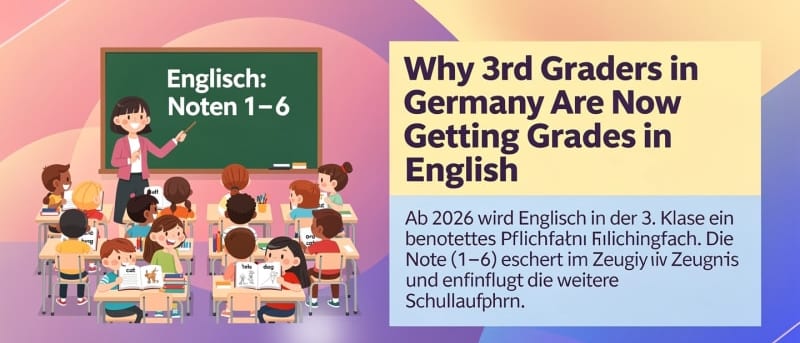
New Primary Subjects: Why 3rd Graders in Germany are Now Getting Grades in English
Breaking News: In 2026, educational shifts in Germany emphasize standardized assessment and core competence building at the primary level. While foreign language instruction—primarily English—has been a compulsory subject for third graders nationwide since 2006, new policy implementations are formalizing the transition to performance-based grading for this age group, making English a mandatory graded subject starting in the 2025/2026 school year.
News Hook: English Grading Introduced for Third Graders in 2026
The German primary school landscape is undergoing a shift toward earlier standardized assessment, particularly in foreign language instruction. Starting with the first-semester report cards in early 2026, third-grade students receive a formal mark (1–6) for English, making it part of their official academic record alongside traditional core subjects like German and Mathematics.
Key Details of the 2026 Grading Implementation
Mandatory Status: From Compulsory Exercise to Graded Subject
As of the 2025/2026 school year, the "Living Foreign Language"—which is English in most German states—has transitioned from a "compulsory exercise" (often ungraded or evaluated with qualitative feedback) to a mandatory subject that requires numerical grading. This represents a significant shift in how English instruction is evaluated and reported.
Report Card Inclusion: Formal Marks Starting Early 2026
Starting with the first-semester report cards in early 2026, third-grade students receive a formal mark (1–6) for English, making it part of their official academic record. This means English grades now appear alongside traditional core subjects, giving parents and teachers a clearer picture of a child's linguistic performance.
Gradual Rollout: Extending to Fourth Grade
This shift began with third grades in late 2025 and is scheduled to extend to all fourth-grade classes by the 2026/2027 school year. This gradual rollout allows schools and teachers to adapt to the new grading requirements while ensuring consistent implementation across all primary grades.
Performance Monitoring: iKMPLUS Reports
For the first time in 2026, reports containing federal and state results on individual competency measurements (iKMPLUS) will be published, assessing fourth-grade performance in reading, math, and English based on tests conducted between 2023 and 2025. This provides comprehensive data on student performance across key subjects.
The Standard Grading Scale (1–6)
When third graders are graded in English, teachers use the standard German primary school scale:
| Grade |
German Term |
English Translation |
Description |
| 1 |
Sehr gut |
Very Good |
Excellent performance |
| 2 |
Gut |
Good |
Performance well above average |
| 3 |
Befriedigend |
Satisfactory |
Average performance |
| 4 |
Ausreichend |
Sufficient |
Performance that meets standard requirements (lowest passing grade) |
| 5 |
Mangelhaft |
Poor/Failed |
Does not meet standards |
| 6 |
Ungenügend |
Insufficient/Failed |
Significant deficiencies |
Contextual Drivers for the Change
Preparation for Secondary Tracking
In Germany, the type of secondary school a child attends (Gymnasium, Realschule, or Hauptschule) is largely determined by grades in the fourth grade. Earlier grading in third grade provides a "diagnostic" year for parents and teachers to gauge a child's linguistic aptitude before high-stakes recommendations. This allows families to better prepare for secondary school decisions.
Competency Standards
Federal authorities (the Kultusministerkonferenz) have revised primary standards to increase compatibility between school levels. The move to grade third-grade English reflects a broader emphasis on "competence orientation" in key areas like linguistics and mathematics, ensuring students meet measurable proficiency standards.
Universal All-Day Schooling
From August 2026, Germany is phasing in a legal right to all-day childcare for all first-graders, which will gradually cover all primary students by 2029. This increased instructional time allows for a more formalized and graded approach to subjects like English that were previously treated as supplementary. The additional time supports more rigorous assessment and measurable outcomes.
Focus on Basics: "Back to Basics" Movement
The move to grade third-grade English also reflects a broader debate on educational priorities. Some education officials have called for shifting focus back to basic German reading and math, leading to a more rigorous, graded approach when foreign languages are taught to ensure measurable proficiency. This ensures that English instruction maintains high standards alongside core subjects.
What This Means for Students and Parents
For third-grade students and their families:
- Formal Assessment: English performance is now formally evaluated with numerical grades
- Report Card Inclusion: English grades appear on official report cards starting early 2026
- Early Preparation: Provides diagnostic information before critical fourth-grade secondary school recommendations
- Standardized Evaluation: Consistent grading scale (1-6) across all subjects
- Performance Tracking: Parents can monitor their child's English progress more clearly
Comparison: Before and After 2026 Grading
| Aspect |
Before 2026 |
After 2026 |
| English Status |
Compulsory exercise (often ungraded) |
Mandatory graded subject |
| Evaluation Method |
Qualitative feedback |
Numerical grades (1-6) |
| Report Card Inclusion |
Not always included |
Formal marks on report cards |
| Grade Levels |
Ungraded or inconsistent |
3rd grade (2026), 4th grade (2026/2027) |
| Secondary School Preparation |
Limited diagnostic information |
Diagnostic year before 4th grade decisions |
| Performance Monitoring |
Limited standardized data |
iKMPLUS reports with federal/state results |
Regional Variations and Implementation
While the grading requirement is being implemented across Germany, there may be slight variations between federal states (Länder) in:
- Specific implementation timelines
- Grading criteria and assessment methods
- Integration with existing curricula
- Teacher training and support resources
Parents should check with their local school or education authority to understand specific details for their region.
Quick Start: What Parents Need to Know
If your child is in third grade or will be entering third grade in 2026:
- Understand the Change: English is now a mandatory graded subject, not just a compulsory exercise
- Review Grading Scale: Familiarize yourself with the 1-6 grading system (1 = excellent, 4 = passing, 5-6 = failing)
- Check Report Cards: English grades will appear on first-semester report cards starting early 2026
- Use Diagnostic Information: Third-grade English grades provide early insight before fourth-grade secondary school recommendations
- Support Learning: Consider additional English support if your child struggles, as grades now impact academic records
Official Sources (One-Click Links)
-
KMK – Primary School Educational Standards (2025/2026)
https://www.kmk.org
(Official Standing Conference guidelines on the 'competence orientation' and standardized 1–6 grading for foreign languages)
-
IQB – iKMPLUS Competency Measurement Reports 2026
https://www.iqb.hu-berlin.de
(The Institute for Educational Quality Improvement portal for the federal and state results in 4th-grade English, Math, and German)
-
Ministry of Education – Primary School Report Card Regulations
https://www.schulministerium.nrw
(State-level verification of the transition from qualitative feedback to formal numerical marks for 3rd graders starting early 2026)
-
Bundesregierung – Legal Entitlement to All-Day Care (Ganztagsförderungsgesetz)
https://www.bundesregierung.de
(Official government confirmation of the August 2026 phased rollout for mandatory all-day schooling support)
-
DAAD – Language Instruction in German Primary Schools
https://www.daad.de
(Academic overview of the German tracking system and why 3rd-grade grades serve as a diagnostic for Gymnasium recommendations)
-
Federal Ministry of Education (BMBF) – 'Back to Basics' Initiative
https://www.bmbf.de
(Official policy background on the prioritization of measurable proficiency in core primary subjects for the 2026 school year)
Last checked: February 2026.
Important Notes:
- English has been compulsory for third graders since 2006, but formal grading is new in 2026
- The grading scale (1-6) is the same standard used for all subjects in German primary schools
- Third-grade grades provide diagnostic information before critical fourth-grade secondary school decisions
- The change is part of a broader "Back to Basics" and quality assurance push in German education
- All-day schooling expansion supports more formalized and graded English instruction