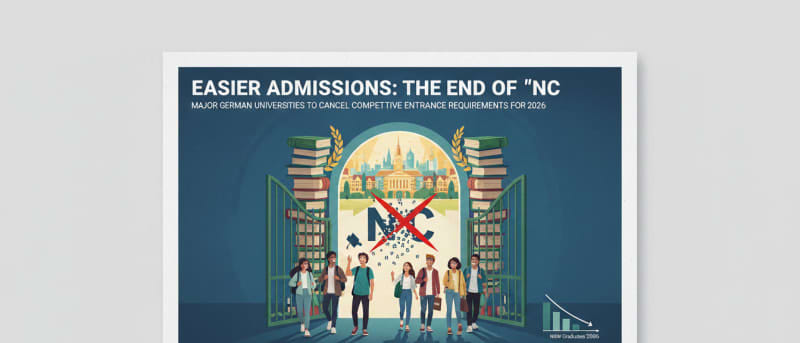
The End of "NC": Major German Universities to Cancel Competitive Entrance Requirements for 2026
Breaking News: In 2026, many German universities are projected to cancel or ease Numerus Clausus (NC)—the competitive grade-point average requirement—due to a significant demographic "dip" in the number of school leavers. This shift represents a fundamental change in German higher education admissions, creating unprecedented opportunities for students who might not have qualified in previous years.
News Hook: The 2026 Demographic "Drought"
The German higher education landscape is undergoing a unique shift characterized by a "demographic dip" that is leading many major universities to lower or cancel their competitive entrance requirements (Numerus Clausus or NC). With fewer local applicants competing for university places, institutions are removing barriers that previously restricted access to popular programs.
Primary Causes
Transition to G9 System
Major states like North Rhine-Westphalia (NRW) and Schleswig-Holstein are switching from a 12-year (G8) to a 13-year (G9) secondary school system. During this transition, the cohort that would have graduated in 12 years is held back for a 13th year, creating a one-year "vacuum" of graduates that directly impacts university admissions.
Resulting Graduate Shortfall
In 2026, NRW alone is expected to produce roughly 40,000 fewer graduates—a nearly 60% drop in the typical student flow—because the senior class will remain in school for an extra year. Schleswig-Holstein experiences a similar decline, following a precedent set by Bavaria, which saw 26,000 fewer graduates during its transition.
National Impact
The Standing Conference of the Ministers of Education and Cultural Affairs (KMK) predicts the number of higher education entrance qualification holders will hit a minimum of 348,400 in 2026, down from over 390,000 in previous years. This represents a reduction of approximately 41,600 graduates nationwide, creating a substantial gap in the annual cohort of new university applicants.
Demographic Trends
This specific educational reform coincides with a broader short-term decline in German first-year student numbers, which are expected to drop to approximately 451,000 in 2026. This demographic trend amplifies the impact of the G9 transition, creating a perfect storm for easier university admissions.
Impact on Admissions
Removal of Competitive Barriers
With fewer local applicants, many universities are expected to lift NC restrictions on numerous programs that previously required high grades for entry. Because the "NC" is a competitive limit based on the number of applicants versus available spots, the massive drop in local applicants is making many programs "admission-free" or zulassungsfrei.
Easier Admission
Universities in affected states are already planning to simplify admission or cancel the NC for popular majors that previously required high GPAs. This includes programs in Engineering, Business, Medicine, Law, and other competitive fields that typically had strict grade requirements.
Direct Enrollment
Many institutions, such as Esslingen University of Applied Sciences and Hochschule Rhein-Waal, are offering programs with no admission restrictions for the 2026 semesters, allowing for direct enrollment. This means students can enroll directly without waiting for admission decisions based on grade point averages.
Strategic Opportunities
This creates a unique window for applicants to gain admission into popular or previously restricted majors at universities in the affected states. Students who might not have qualified in previous years now have opportunities to study their preferred subjects at top German universities.
Impact on International Students
Proactive Recruitment
German universities are increasingly targeting international talent to offset the decline in domestic student numbers. While domestic numbers drop, international student enrollment is at record highs, surpassing 402,000 in early 2026. Universities are leveraging international recruitment to fill vacant spots.
High Demand for Master's Programs
While undergraduate numbers dip, international enrollment remains at record highs, especially for English-taught Master's programs (over 2,700 available programs). This creates opportunities for international students seeking advanced degrees in Germany.
Dual Programs
The shortage of graduates is also driving higher demand from companies for students in dual education programs, offering better terms for applicants. These programs combine academic study with practical work experience, often with financial support from partner companies.
Other Changes for 2026
Fees for Non-EU Students in Bavaria
Following the Technical University of Munich (TUM), other Bavarian institutions like Ingolstadt University of Applied Sciences (THI) will begin charging non-EU/EEA tuition fees (up to €1,200/semester) starting in the 2026 summer semester. Despite the broader trend of easing NCs, some Bavarian universities have introduced tuition fees for non-EU students.
Language & Exam Requirements
While NC may be lower, roughly 50% of public universities may now require GRE scores for certain tech and engineering programs, and many are enforcing higher German proficiency (A2/B1) even for English-taught degrees. This means that while grade requirements may be relaxed, other admission criteria remain important.
Key Deadlines for 2026 Intake
Summer Semester 2026
Applications generally close between January 15 and March 2026 for the summer semester intake. Students interested in starting in the summer should prepare their applications well in advance.
Winter Semester 2026/2027
Applications for international students often start in December 2025 or March 2026, with deadlines typically around July 15, 2026. The Winter Semester begins in October 2026, so students should plan accordingly for visa applications and arrival.
What This Means for Students
For students planning to study in Germany in 2026:
- Easier Access: Programs that were previously highly competitive may now be admission-free
- Direct Enrollment: Many programs allow direct enrollment without NC restrictions
- Popular Majors Accessible: Competitive programs in Engineering, Business, and other fields may become more accessible
- International Opportunities: Record-high international enrollment creates opportunities for foreign students
- Dual Study Benefits: Increased demand for dual education programs offers better terms
Comparison: Before and After 2026 NC Changes
| Aspect |
Before 2026 |
After 2026 (NC Cancellation) |
| NC Requirements |
Strict grade-based restrictions |
Many programs admission-free |
| Competitive Programs |
High GPA required |
Direct enrollment possible |
| Admission Process |
Competitive selection |
Simplified or direct enrollment |
| Popular Majors |
Restricted access |
More accessible |
| International Students |
Standard competition |
Proactive recruitment |
| Dual Programs |
Standard demand |
Higher demand, better terms |
Regional Variations
Not all German states and universities are affected equally:
- Most Affected: NRW and Schleswig-Holstein face the largest impact with 60% fewer graduates
- Moderate Impact: Other states transitioning to G9 may experience smaller reductions
- Bavaria: Despite easier admissions, some universities introduce tuition fees for non-EU students
- Unchanged: States that maintained G9 or completed the transition earlier are not affected
Important Considerations
While NC cancellation creates opportunities, students should be aware that:
- This is temporary: The G9 transition creates a one-time gap—2027 will return to normal
- Other requirements remain: Language proficiency, GRE scores, and academic qualifications still apply
- Tuition fees in Bavaria: Some Bavarian universities charge up to €1,200/semester for non-EU students
- Not all programs are affected: Some universities and programs may maintain NC restrictions
- Preparation still matters: While admission may be easier, academic success requires thorough preparation
Official Sources (One-Click Links)
-
KMK – Statistical Forecast of School Leavers (2026 Update)
https://www.kmk.org
(Official Standing Conference data verifying the national dip to 348,400 graduates due to the G9 system transition)
-
Ministry of Education NRW – The G9 Transition and University Impact
https://www.schulministerium.nrw
(State government confirmation of the 2026 graduate 'vacuum' and the resulting 60% drop in local university applicants)
-
DAAD – International Students in Germany 2025/26 Report
https://www.daad.de
(Official DAAD press release verifying the record 402,000+ international enrollment used to offset domestic declines)
-
Hochschulkompass – Admission-Free (NC-frei) Degree Search
https://www.hochschulkompass.de
(The official portal for searching 'Zulassungsfrei' programs at Esslingen, Rhein-Waal, and other universities for 2026)
-
TH Ingolstadt – Non-EU Tuition Fees for Summer 2026
https://www.thi.de
(Institutional verification of the new €1,200/semester fee for non-EU/EEA students starting in the 2026 summer semester)
-
Uni-Assist – Application Deadlines for Winter 2026/27
https://www.uni-assist.de
(Official deadline tracker confirming the July 15, 2026, cutoff for international applicants for the Winter intake)
Last checked: February 2026.
Quick Start: What Students Need to Know
If you're planning to apply for German universities in 2026:
- Research NC-Free Programs: Check which universities and programs have cancelled NC restrictions
- Understand Requirements: While NC may be cancelled, language proficiency and other criteria still apply
- Check Deadlines: Summer Semester (Jan 15-Mar 2026), Winter Semester (July 15, 2026)
- Consider Regional Variations: NRW and Schleswig-Holstein offer the best opportunities
- Prepare Documents: Language certificates, GRE scores (if required), academic transcripts
- Be Aware of Fees: Some Bavarian universities charge tuition for non-EU students
Important Notes:
- NC cancellation is primarily in NRW and Schleswig-Holstein due to G9 transition
- Many programs are now "admission-free" (zulassungsfrei) allowing direct enrollment
- International student enrollment is at record highs (over 402,000)
- Some Bavarian universities charge up to €1,200/semester for non-EU students
- GRE scores may be required for tech and engineering programs at 50% of universities
- Higher German proficiency (A2/B1) may be required even for English-taught degrees