Easier Admissions: Why 2026 is the Best Year to Apply for German Universities in NRW and Schleswig-Holstein
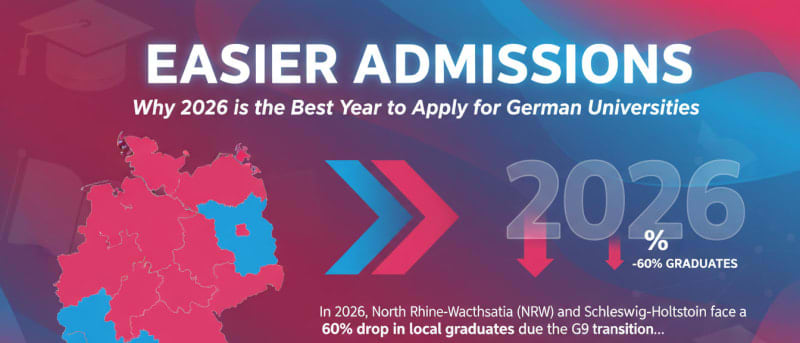
Breaking News: In 2026, the German states of North Rhine-Westphalia (NRW) and Schleswig-Holstein are experiencing a significant temporary drop in the number of local high school graduates. This shift creates a rare opportunity for international students applying for the Winter Semester 2026, as many universities are expected to lower or cancel admission restrictions (NC) to fill their courses.
News Hook: The 2026 Admission Opportunity
A structural change in the German school system has created a unique "gap year" for university admissions in North Rhine-Westphalia (NRW) and Schleswig-Holstein. This shift significantly improves the chances for international students applying for the Winter Semester 2026, making it potentially the easiest year in recent history to gain admission to German universities in these states.
Why 2026 is an Ideal Year to Apply
Massive Reduction in Local Applicants
NRW is facing a drop of approximately 40,000 graduates—nearly a 60% decrease compared to typical years. Schleswig-Holstein is experiencing a similar decline, following a precedent set by Bavaria, which saw 26,000 fewer graduates during its transition. This dramatic reduction in local applicants creates unprecedented opportunities for international students.
The "G9" Educational Shift
The primary cause is both states switching from a 12-year (G8) to a 13-year (G9) school system, resulting in a year where no regular senior class graduates. During this transition, the cohort that would have graduated in 12 years is held back for a 13th year, creating a one-year "vacuum" of graduates. This structural change directly impacts university admission competition.
Lowered Admission Restrictions (NC)
To prevent empty lecture halls and fill courses, many universities are expected to cancel or lower Numerus Clausus (NC) requirements, which normally restrict entry based on high grade averages. The Numerus Clausus system limits admissions when applicants exceed available seats, but with drastically fewer local applicants, universities must adjust their admission criteria to maintain enrollment.
Easier Admission for Popular Majors
This demographic dip allows students with average grades to potentially secure spots in competitive programs that were previously out of reach. Popular fields such as Engineering, Business, Medicine, and Law—which typically require perfect or near-perfect grade point averages (GPA)—may become more accessible for the 2026 intake.
Impact on Admission Restrictions (NC)
Cancellation of Restrictions
Because the local applicant pool has shrunk so drastically, many universities are expected to cancel or significantly lower NC thresholds for the 2026 intake to avoid empty lecture halls. This represents a rare opportunity for students who might not have qualified in previous years.
Competitive Majors Become Accessible
This provides a rare window to enter popular fields—such as Engineering or Business—that typically require a perfect or near-perfect grade point average (GPA). Students who previously would not have met the high NC requirements may now have a chance to study their preferred subjects at top German universities.
Strategic Advantages for 2026 Applicants
Dual Education Demand
With fewer local graduates, companies offering dual study programs (combining work and study) are facing higher demand for international talent. This creates additional opportunities for students interested in combining academic study with practical work experience, often with financial support from partner companies.
Faster Processing
A lower volume of total applications may lead to faster document verification times at uni-assist and quicker admission decisions from universities. This streamlined process benefits international students who need to complete visa applications and other preparations in a timely manner.
Timeline for Winter Semester 2026
Application Portals Open: May 2026
University application portals for the Winter Semester 2026 intake open in May 2026. This is when students can begin submitting their applications through uni-assist or direct university portals.
Application Deadline: July 15, 2026
The application deadline is July 15, 2026, for most public universities. This deadline is strict and applies to almost all public universities in Germany. Late applications are typically not accepted, so timely submission is crucial.
Semester Start: October 2026
The Winter Semester 2026 begins in October 2026. Students who receive admission should plan to arrive in Germany before the semester starts to complete enrollment, find accommodation, and attend orientation programs.
Critical Timeline for Winter Semester 2026
To capitalize on this opportunity, you must follow these key dates:
Documentation Prep (Now – March 2026)
- Translate academic transcripts into German or English
- Obtain your APS certificate (if required for your country)
- Open a Blocked Account with the required €11,904 for the 2025/2026 academic year
- Prepare language certificates (German B2/C1 or English proficiency tests if applicable)
- Gather all required documents for university applications
Application Window (May – July 15, 2026)
- Submit applications through uni-assist or direct university portals
- Apply to multiple universities to maximize chances
- Ensure all documents are complete and properly certified
- Meet the strict July 15 deadline for public universities
Visa Application (August – September 2026)
- Apply for your student visa immediately upon receiving an admission letter
- Allow for 4–8 weeks of processing time
- Prepare all visa documents including admission letter, blocked account proof, health insurance, and passport
- Schedule visa appointment at German embassy or consulate in your country
Official Sources (One-Click Links)
-
Ministry of Education NRW – The G9 Transition Impact 2026
https://www.schulministerium.nrw
(Official state government confirmation of the 2026 'gap year' and the resulting 60% drop in local high school graduates)
-
KMK – 2026 Statistical Forecast for School Leavers
https://www.kmk.org
(The Standing Conference's data verifying the national dip to 348,400 graduates due to structural educational shifts)
-
Hochschulkompass – Degree Search for NRW & Schleswig-Holstein
https://www.hochschulkompass.de
(The official database to filter for 'NC-free' programs and admission-free majors in the affected northern states for 2026)
-
Uni-Assist – International Application Portal & Deadlines
https://www.uni-assist.de
(Official confirmation of the July 15, 2026, deadline for Winter Semester applications at most public universities)
-
DAAD – International Student Admission Database
https://www.daad.de
(Official tool to verify if your specific foreign high school diploma is recognized for direct entry in the 2026 cycle)
-
Auswärtiges Amt – Student Visa Financial Proof (€11,904)
https://www.auswaertiges-amt.de
(Federal Foreign Office verification of the mandatory blocked account requirement for the 2026/2027 study year)
Last checked: February 2026.
Key Resources for Applicants
Hochschulkompass
Use this official database to find all degree programs in NRW and Schleswig-Holstein. Hochschulkompass provides comprehensive information about universities, programs, admission requirements, and application procedures.
Uni-Assist
The primary portal for international students to submit their documents to German universities. Uni-assist evaluates international qualifications and forwards applications to universities, streamlining the process for students from outside Germany.
DAAD Admission Database
Verify if your specific high school diploma or university degree is recognized in Germany. The DAAD (German Academic Exchange Service) provides tools to check recognition of international qualifications and understand admission requirements.
Study in Germany Requirements
A comprehensive checklist for international student visas, finances, and language certificates. This resource helps students understand all requirements for studying in Germany, including visa procedures, financial proof, health insurance, and language proficiency requirements.
What This Means for International Students
For international students planning to study in Germany:
- Better Admission Chances: Significantly improved opportunities, especially in NRW and Schleswig-Holstein
- Access to Competitive Programs: Programs that were previously highly competitive may now be more accessible
- Lower NC Requirements: Many universities may cancel or lower Numerus Clausus restrictions
- Faster Processing: Reduced application volume may lead to quicker decisions
- Dual Study Opportunities: Increased demand for international students in dual education programs
Comparison: Typical Years vs. 2026
| Aspect |
Typical Years |
2026 (G9 Transition) |
| Local Graduates (NRW) |
~70,000-74,000 |
~30,000-34,000 (40,000 fewer) |
| NC Requirements |
Standard restrictions |
Lowered or cancelled |
| Competitive Majors |
High GPA required |
More accessible |
| Application Competition |
High |
Significantly reduced |
| Processing Times |
Standard |
Potentially faster |
| International Student Advantage |
Standard competition |
Significantly improved |
Important Considerations
While 2026 presents unique opportunities, students should be aware that:
- This is a one-time opportunity: The G9 transition creates a temporary gap—2027 will return to normal graduation numbers
- Standard requirements still apply: Blocked accounts (€11,904), language certificates, and academic qualifications remain mandatory
- Not all universities will lower NC: Some programs may maintain their admission restrictions
- Preparation is still essential: While admission may be easier, academic success still requires thorough preparation
- Regional variations exist: Other German states may not experience the same opportunities
Quick Start: Application Checklist for Winter Semester 2026
If you're planning to apply for Winter Semester 2026:
- Research Programs: Use Hochschulkompass to find programs in NRW and Schleswig-Holstein
- Prepare Documents: Translate transcripts, obtain APS certificate (if needed), open blocked account (€11,904)
- Check Requirements: Verify degree recognition using DAAD database
- Submit Applications: Apply through uni-assist or direct portals between May and July 15, 2026
- Apply for Visa: Once admitted, apply for student visa immediately (allow 4-8 weeks)
- Plan Arrival: Arrive in Germany before October 2026 semester start
Important Notes:
- The July 15, 2026 deadline is strict for most public universities
- Blocked account requirement is €11,904 for the 2025/2026 academic year
- APS certification may be required depending on your country of origin
- Language requirements (German B2/C1 or English proficiency) still apply
- This is a temporary opportunity—2027 will see normal graduation numbers