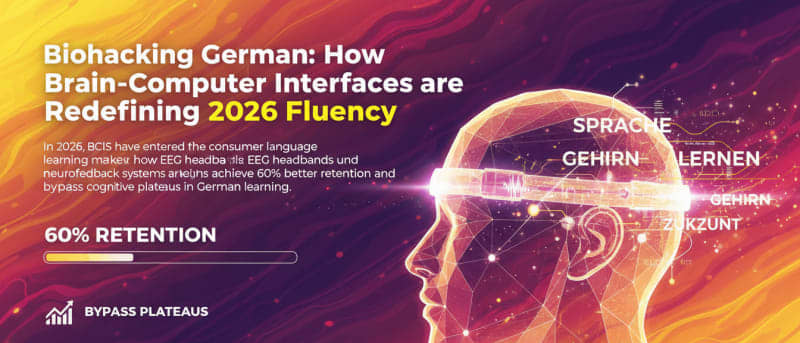
Biohacking German: How Brain-Computer Interfaces are Redefining 2026 Fluency
In 2026, some companies and researchers are exploring brain-computer interfaces (BCIs) and neurofeedback for learning—including language learning. Wearable EEG devices and “neuroadaptive” apps are being marketed to learners who want to optimise focus or review timing. The science behind using neural data for everyday language learning is still young: most evidence is from labs or small studies, not from large-scale trials showing that BCIs beat proven methods. This guide explains what’s out there, what’s realistic, and why consistent practice and proven resources remain the foundation for German fluency.
What this means for you
Don’t rely on BCI or neurofeedback for fluency. There is no robust evidence that consumer brain wearables or “neuroadaptive” apps reliably outperform traditional study (courses, immersion, spaced repetition, speaking practice). If you’re curious, you can try neurofeedback or focus-tracking as an
optional extra—e.g. to see when you’re most focused—but treat it as experimental. For real progress, prioritise:
regular exposure (reading, listening, speaking),
structured courses (e.g.
Goethe-Institut,
DW Deutsch lernen), and
active use of German. “Biohacking” may one day support learning; in 2026 it’s not a shortcut to fluency.
What Exists in 2026: BCI and Neurofeedback for Learning
Some products aim to use brain signals to improve learning:
- EEG headbands and earbuds: Consumer devices that measure electrical activity (e.g. focus, relaxation). The idea is to show content when you’re in a “focused” or “flow” state or to suggest breaks when signs of fatigue appear.
- Neurofeedback loops: Software that reacts to your reported or inferred mental state (e.g. “alpha” or “theta” bands) by adjusting difficulty or switching to passive content.
- Research concepts: Lab work on “silent speech” decoding or semantic processing (e.g. N400) is advancing, but practical use in everyday language apps is still experimental.
These tools are niche and often expensive. Claims like “60% better retention” or “95% accuracy” for silent speech in consumer language learning are not backed by public, reproducible studies you can check. Treat marketing claims with caution.
What Actually Improves German Fluency
Evidence-based language learning still rests on:
- Comprehensible input: Reading and listening at a level you can mostly follow.
- Output: Speaking and writing, with feedback where possible.
- Spaced repetition: Reviewing vocabulary and structures at intervals (e.g. flashcards, structured courses).
- Consistency: Regular practice over months and years.
- Motivation and context: Using German for things you care about (work, hobbies, media).
No consumer BCI has been shown to replace these. At best, neurofeedback might help you notice when you’re focused or tired—useful for scheduling study, but not a substitute for the work itself.
If You Want to Explore Neurofeedback Anyway
If you’re interested in focus tracking or neurofeedback as a supplement:
- Consumer EEG devices (headbands, some earbuds) exist; quality and evidence for language learning vary. Read independent reviews and don’t expect miracles.
- Some workshops or “biohacking” events (e.g. in Germany) cover neurofeedback for cognition; they are not language courses. Professional certification is for practitioners, not a shortcut to German.
- OpenBCI and similar open-source hardware are used in research and by hobbyists; integrating them with language apps is a technical project, not an off-the-shelf solution.
Costs range from under a few hundred euros/dollars for basic consumer devices to much more for clinical-grade or training programmes. We don’t recommend prioritising this over proven learning resources.
Events and Courses (2026)
Various 2026 events mention neurofeedback, “brain health,” or AI and learning (e.g. Biohacking Days, university summer schools, FIBO). For German language itself, use established providers: Goethe-Institut, DW Deutsch lernen, and university or certified language courses. Scholarship programmes (e.g. for international students) are listed on DAAD and university sites—check current deadlines.
Reference (Evidence-Based Learning and Context)
For learning German in a way that is well supported by evidence:
For an overview of BCI and language (research context, not consumer products): MDPI Applied Sciences – BCI and language decoding (review).
Last checked: February 2026.
Next Steps
Put your time and money into proven methods: structured German courses, daily exposure (podcasts, series, reading), and speaking practice (tandem, lessons, immersion). If you still want to try a focus or neurofeedback device, use it only as an optional add-on and don’t expect it to replace consistent study. For courses and materials: Goethe-Institut, DW Deutsch lernen.